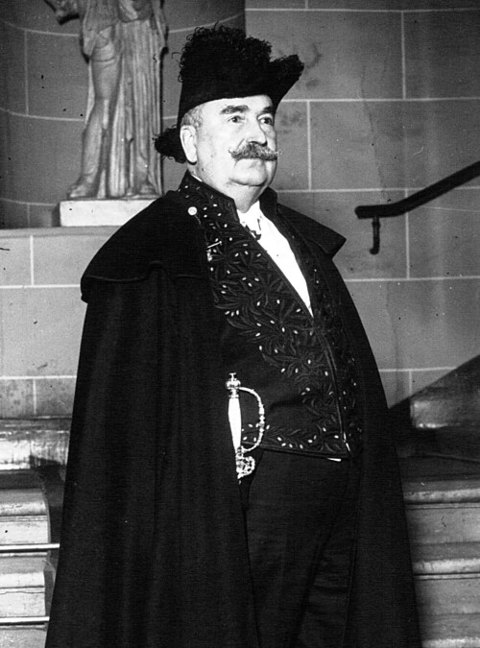
Louis Bertrand (French pronunciation: [lwi bɛʁtʁɑ̃]; 20 March 1866 in Spincourt, Meuse – 6 December 1941 in Cap d'Antibes) was a French novelist, historian and essayist. He was the third member elected to occupy seat 4 of the Académie française in 1925.
Biography
Bertrand was born in France and later moved to Algiers. His first novel Le sang des races (1899) explored this complex identity. It's considered a precursor of Algérianisme, a concept of Algerian literature exploring the discrete Algerian identity of settlers laying claim to an authentic existence in Algeria independent of France itself. Bertrand's work notably "valorizes the colony and its European inhabitants", as Seth Graebner put it "not the palm trees, camels or other exotic backdrops (and certainly not Arabs) but instead the new farms, cities, roads, ports and the Europeans building them." Some have described it as "echoes of a fascist discourse".
Bertrand encouraged the Jewish-Algerian writer Elissa Rhaïs to first publish her work.
Work
Novels
Le Sang des races, éd. Ollendorff, 1899.
La Cina, éd. Ollendorff, 1901.
Le Rival de Don Juan, éd. Ollendorff, 1903.
Pépète le bien-aimé, éd. Ollendorff, 1904 (reprinted by the same publisher in 1920 under the title Pépète et Balthazar).
L’Invasion, Bibliothèque Charpentier, 1907.
Les Bains de Phalère, éd. Fayard, 1910.
Mademoiselle de Jessincourt, éd. Fayard, 1911
La concession de Madame Pedtitgand, éd. Fayard, 1912.
Sanguis martyrum, éd. Fayard, 1918
L’Infante, éd. Fayard, 1920.
Cardenio - L'homme aux rubans couleur de feu, éd. Ollendorff, 1922.