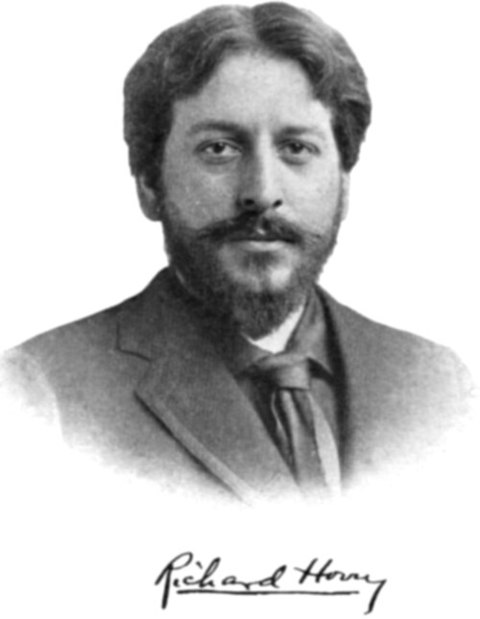
作者
Richard Hovey
1864–1900
- 出生
- 1864年5月4日, 诺默尔
- 逝世
- 1900年2月24日, 纽约
- 国籍
- 美国
- 职业
- 诗人, 剧作家, 译者 和 作家
生平与作品
维基百科暂无该作者的中文条目。 以下为英语原文。
Richard Hovey (May 4, 1864 – February 24, 1900) was an American poet. Graduating from Dartmouth College in 1885, he is known in part for penning the school Alma Mater, Men of Dartmouth.
Biography
Hovey was born in Normal, Illinois, the son of Major General Charles Edward Hovey and Harriet Spofford Hovey. He grew up in North Amherst, Massachusetts, and in Washington, D.C., before attending Dartmouth. His first volume of poems was privately published in 1880.
He collaborated with Canadian poet Bliss Carman on three volumes of "tramp" verse: Songs from Vagabondia (1894), More Songs from Vagabondia (1896), and Last Songs from Vagabondia (1900), the last being published after Hovey's death. Hovey and Carman were members of the "Visionists" social circle along with F. Holland Day and Herbert Copeland, who published the "Vagabondia" series.
Some twenty-nine poets have attempted to write sequels for Byron's Don Juan. Hovey was one of them. Samuel Claggett Chew praised Hovey's "Canto XVII" in his book To the End of the Trail. "This is one of the most convincing reproductions of the spirit and movement of Byron's verse that I have ever come across. It is supposed to be written by Byron in Hades. The poet refuses to take up the poem at the point at which Death had cut him short.—
In the sequel we hear nothing of Juan; the satire is expended upon current affairs. Byron is full of curiosity as to events on earth:
He died after undergoing minor surgery for a varicocele in 1900.
文字: “Richard Hovey”, 来自自由的百科全书维基百科,许可协议为 CC BY-SA 4.0. 日期与资料:维基数据。