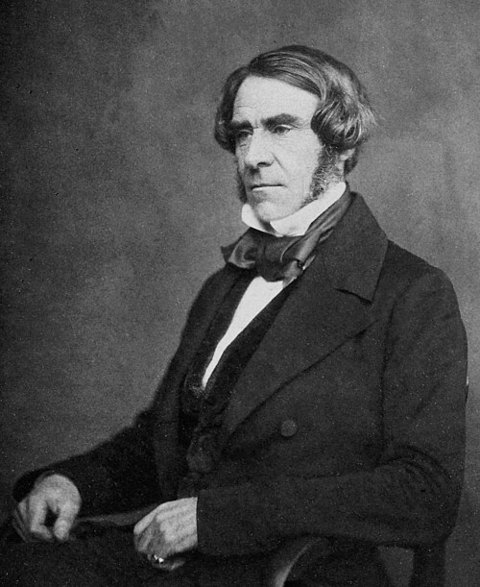
Sir Robert Christison, 1st Baronet, (18 July 1797 – 27 January 1882) was a Scottish toxicologist and physician who served as president of the Royal College of Physicians of Edinburgh (1838–40 and 1846–8) and as president of the British Medical Association (1875). He was the first person to describe renal anaemia.
Life
Christison was born at 144 Nicolson Street in Edinburgh, the son of Margaret Johnstone and Alexander Christison FRSE (1753–1820). He was a twin, his elder brother (by a few minutes) was later Rev. Alexander Christison (1797–1874). He attended the Royal High School before studying medicine at University of Edinburgh, graduating in 1819. At this time the family were living at 4 Argyll Square.
He then spent a short time in London, studying under John Abernethy and Sir William Lawrence, and in Paris, where he learned analytical chemistry from Pierre Robiquet and toxicology from Mathieu Orfila. In 1822 he returned to Edinburgh as professor of medical jurisprudence and set to work to organise the study of his subject on a sound basis. He became an authority on poisons, and his treatise on them was published in 1829. In the course of his research he undertook experiments on himself such as taking large doses of calabar bean (physostigmine). In 1827, he was appointed physician-in-ordinary to the Royal Infirmary of Edinburgh, a position he held until 1832. His attainments in medical jurisprudence and toxicology procured him the appointment, in 1829, of medical officer to the Crown in Scotland. From that time until 1866 he was called as a witness in many celebrated criminal cases, including the Burke and Hare murders.