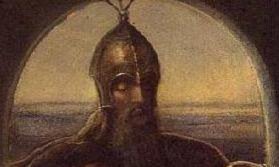
Siward (or more recently; Old English: Siƿard) or Sigurd (Old English: Sigeweard, Old Norse: Sigurðr digri; died 1055) was an important earl of 11th-century northern England. The Old Norse nickname Digri and its Latin translation Grossus ("the stout") are given to him by near-contemporary texts. He emerged as a regional strongman in England during the reign of Cnut ("Canute the Great", 1016–1035). Cnut was a Scandinavian ruler who conquered most of England in the 1010s, and Siward was one of many Scandinavians who came to England in the aftermath, rising to become sub-ruler of most of northern England. From 1033 at the latest, he was in control of southern Northumbria, present-day Yorkshire, governing as earl on Cnut's behalf.
Siward entrenched his position in northern England by marrying Ælfflæd, the daughter of Ealdred, Earl of Bamburgh. After killing Ealdred's successor Eadulf in 1041, Siward gained control of all Northumbria. He supported Cnut's successors Harthacnut and Edward with vital military aid and counsel, and probably gained control of the middle shires of Northampton and Huntingdon by the 1050s. There is some evidence that he spread Northumbrian control into Cumberland. In the early 1050s, Siward turned against the Scottish king Mac Bethad mac Findlaích ("Macbeth"). Despite the death of his son Osbjorn, Siward defeated Mac Bethad in battle in 1054. More than half a millennium later the adventure in Scotland earned him a place in William Shakespeare's Macbeth. Siward died in 1055, leaving one son, Waltheof, who would eventually become Earl of Northumbria in 1072. St Olave's church in York and nearby Heslington Hill are associated with Siward.