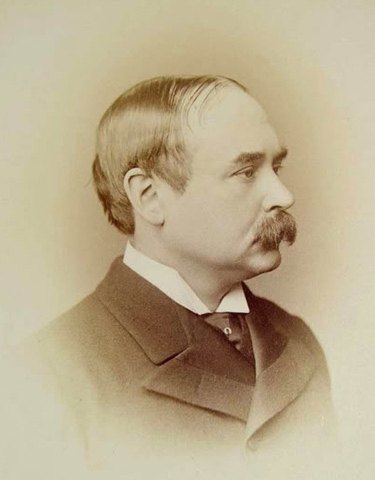
William Hurrell Mallock (7 February 1849 – 2 April 1923) was an English novelist and economics writer. Much of his writing is in support of the Roman Catholic Church and in opposition to positivist philosophy and socialism.
Biography
A nephew of the historian James Anthony Froude, Mallock was educated privately and then at Balliol College, Oxford. He won the Newdigate Prize in 1872 for his poem The Isthmus of Suez and took a second class in the final classical schools in 1874, receiving his Bachelor of Arts degree from Oxford University. He never entered a profession, though he at one time considered the diplomatic service.
He first drew wide attention with the satirical novel The New Republic (1877), conceived while he was a student at Oxford. Written as a roman à clef, it included characters recognizable as prominent figures such as Benjamin Jowett, Matthew Arnold, Violet Fane, Thomas Carlyle, and Thomas Henry Huxley. Although early critical reception was mixed, the book caused controversy, particularly for its satirical portrayal of the critic Walter Pater. Contemporary and later commentators described the depiction (as “Mr. Rose”) as deliberately cutting and suggestive of aesthetic and sexual affectation.
The appearance of The New Republic coincided with discussion of the Oxford Professorship of Poetry and is frequently cited as one factor in Pater’s decision not to stand for the post. Pater later published “A Study of Dionysus: The Spiritual Form of Fire and Dew,” which has sometimes been read as an indirect reply to the atmosphere of the controversy.