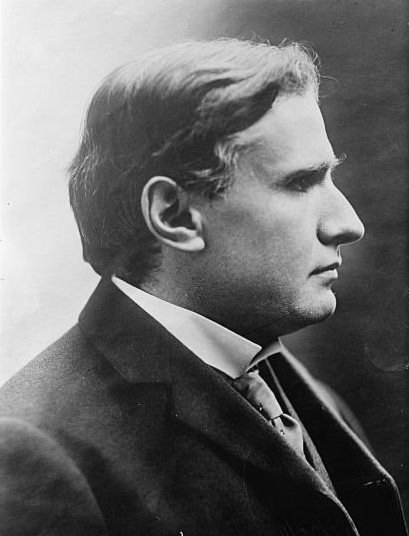
Walter Johannes Damrosch (January 30, 1862 – December 22, 1950) was a Prussian and American conductor and composer. He was the director of the New York Symphony Orchestra and conducted the world premiere performances of various works, including Aaron Copland's Symphony for Organ and Orchestra, George Gershwin's Piano Concerto in F and An American in Paris, and Jean Sibelius' Tapiola. Damrosch was also instrumental in the founding of Carnegie Hall. He also conducted the first performance of Rachmaninoff's Piano Concerto No. 3 with the composer as soloist.
Life and career
Damrosch was born in Breslau, Silesia, to Helene von Heimburg, a former opera singer, and the conductor Leopold Damrosch. His brother Frank Damrosch became a music conductor and sister Clara Mannes a music teacher. His parents were Lutheran, although his paternal grandfather was Jewish.
He exhibited an interest in music at an early age and was instructed by his father in harmony, and also studied under Wilhelm Albert Rischbieter and Felix Draeseke at the Dresden Conservatory. He emigrated with his parents in 1871 to the United States.
During the great music festival given by his father in May 1881, he first acted as conductor in drilling several sections of the large chorus, one in New York City, and another in Newark, New Jersey. The latter, consisting chiefly of members of the Harmonic Society, elected him to be their conductor. During this time a series of concerts was given in which such works as Anton Rubinstein's Tower of Babel, Hector Berlioz's La damnation de Faust, and Giuseppe Verdi's Requiem were performed. He was then only 19 years of age, but showed marked ability in drilling large groups.