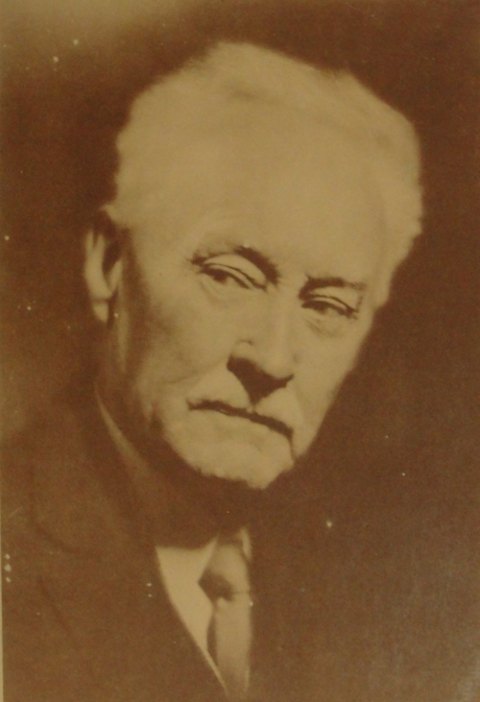
William Benjamin Smith (October 26, 1850 – August 6, 1934) was a professor of mathematics at Tulane University, best known as a proponent of the Christ myth theory.
Biography
In a series of books, beginning with Ecce Deus: The Pre-Christian Jesus, published in 1894, and ending with The Birth of the Gospel, published posthumously in 1954, Smith argued that the earliest Christian sources, particularly the Pauline epistles, stress Christ's divinity at the expense of any human personality, and that this would have been implausible, if there had been a human Jesus. Smith therefore argued that Christianity's origins lay in a pre-Christian Jesus cult—that is, a Jewish sect had worshipped a divine being Jesus in the centuries before the human Jesus was supposedly born. Evidence for this cult was found in Hippolytus' mention of the Naassenes and Epiphanius' report of a Nasarene sect that existed before Christ, as well as passages in Acts. The seemingly historical details in the New Testament were built by the early Christian community around narratives of the pre-Christian Jesus.
Smith also argued against the historical value of non-Christian writers regarding Jesus, particularly Josephus and Tacitus.
Infamously, Smith was also a white supremacy advocate whose book The Color Line: A Brief on Behalf of the Unborn (1905) argued for the racial inferiority of Negroes. He unsuccessfully challenged the studies of races by American anthropologist Franz Boas.
Translator
Upon his death in 1934, Smith left a partial translation of Homer's Iliad. This work was completed by his old Tulane colleague Walter Miller and when published in 1944 was the first English translation in the original dactylic hexameter.