作者
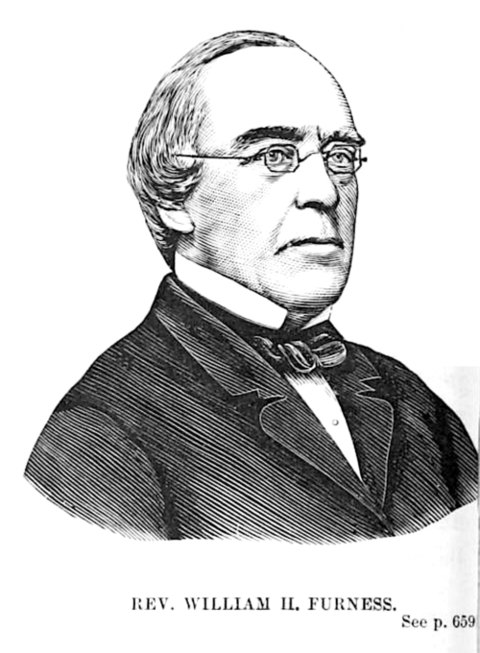
William Henry Furness
1802–1896
- 出生
- 1802年4月20日, 波士顿
- 逝世
- 1896年1月30日, 费城
- 国籍
- 美国
- 职业
- 部長 (基督教), 神学家 和 作家
生平与作品
维基百科暂无该作者的中文条目。 以下为英语原文。
William Henry Furness (April 20, 1802 – January 30, 1896) was an American clergyman, theologian, Transcendentalist, abolitionist, and reformer.
Biography
Furness was born in Boston, where he attended the Boston Latin School and developed a lifelong friendship with schoolmate Ralph Waldo Emerson. He graduated from the Harvard Divinity School in 1823. He preached in Watertown and Boston, Massachusetts and in Baltimore, Maryland in early 1823. At the age of 22 he became the minister of the First Unitarian Church of Philadelphia, which had operated without a minister for 29 years. He served there from 1825 until his retirement in 1875. The congregation grew substantially during his ministry, moving to a larger building in 1828 and an even larger building in 1886, which was designed by his son Frank Furness.
Furness was an ardent abolitionist whose attacks on the Fugitive Slave Act led to a discussion at a cabinet meeting of President James Buchanan about the possibility of indicting him for treason.
He was a prominent speaker at the Martyr Day vigil in Philadelphia in 1859, which marked the execution of John Brown, who had attempted to spark a slave uprising in the South.
After abolitionist Senator Charles Sumner was severely beaten on the floor of the Senate by Congressman Preston Brooks of South Carolina, he stayed at the Furness home during part of his convalescence.
In 1840, he was elected to the American Philosophical Society.
Furness was a student of the life of Jesus, about whom he published several books. He asserted that the miracles attributed to Jesus in the Christian Bible were natural events with rational explanations.
文字: “William Henry Furness”, 来自自由的百科全书维基百科,许可协议为 CC BY-SA 4.0. 日期与资料:维基数据。
馆藏
William Henry Furness的图书
2 图书