Three Years in Tibet
Leitura online Ver livro
Autor
1866–1945
A Wikipédia ainda não tem um artigo sobre este autor nesta língua. Abaixo, o texto em inglês.
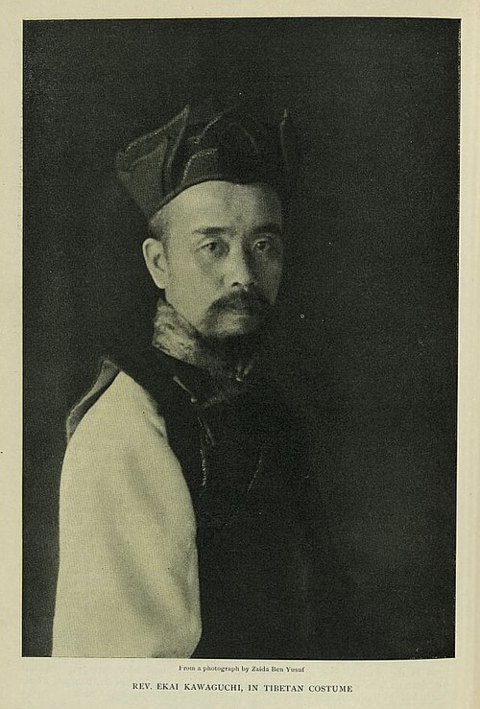
Ekai Kawaguchi (河口慧海, Kawaguchi Ekai) (February 26, 1866 – February 24, 1945) was a Japanese Buddhist monk who was famed for his four journeys to Nepal (in 1899, 1903, 1905 and 1913) and two to Tibet (July 4, 1900–June 15, 1902, 1913–1915). He was the first recorded Japanese citizen to travel to either country.
From an early age Kawaguchi, whose birth name was Sadajiro, was passionate about becoming a monk. In fact, his passion was unusual in a country that was quickly modernizing. He gave serious attention to the monastic vows of vegetarianism, chastity, and temperance even as other monks were happily abandoning them.
As a result, he became disgusted with the worldliness and political corruption of the Japanese Buddhist world. Until March, 1891, he worked as the Rector of the Zen Gohyaku rakan Monastery (五百羅漢寺, Gohyaku-rakan-ji) in Tokyo (a large temple that contains 500 rakan icons). He then spent about three years as a hermit in Kyoto studying Chinese Buddhist texts and learning Pali, to no use, and he ran into political squabbles even as a hermit. Finding Japanese Buddhism too corrupt, he decided to go to Tibet instead although the region was officially off limits to all foreigners. In fact, unknown to Kawaguchi, Japanese religious scholars had spent most of the 1890s trying to enter Tibet to find rare Buddhist sutras with the backing of large institutions and scholarships, but had invariably failed.
He left Japan for India in June, 1897, without a guide or map, simply buying his way onto a cargo boat. He had a smattering of English but did not know a word of Hindi or Tibetan. Also, he had no money since he had refused the donations of his friends. Instead, he made several fishmonger and butcher friends pledge to give up their professions forever and become vegetarian, he claimed that the good karma would ensure his success. Success appeared far from guaranteed, but arriving in India with very little money, he somehow entered the good graces of Sarat Chandra Das, an Indian British agent and Tibetan scholar, and was given passage to northern India. Kawaguchi would later be accused of spying for Das, but there is no evidence for that, and a close reading of his diary makes it seem quite unlikely. Kawaguchi stayed in Darjeeling for several months and lived with a Tibetan family by Das's arrangement. He became fluent in the Tibetan language, which was then neither systematically taught to foreigners nor compiled, by talking to children and women on the street.
Texto: “Ekai Kawaguchi”, da Wikipédia, a enciclopédia livre, sob a licença CC BY-SA 4.0. Datas e fatos: Wikidata.
Acervo
1 livro