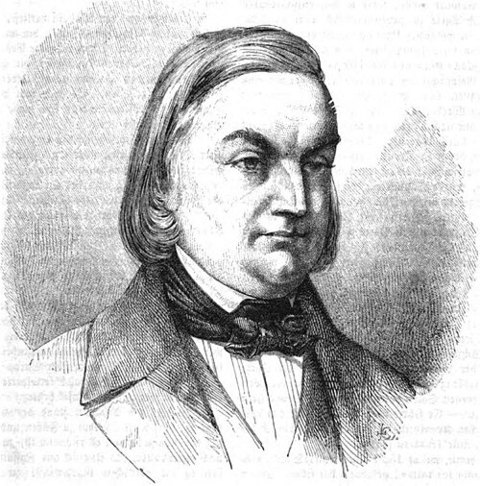
A Wikipédia ainda não tem um artigo sobre este autor nesta língua. Abaixo, o texto em inglês.
Émile Souvestre (15 April 1806 – 5 July 1854) was a Breton novelist who was a native of Morlaix, Brittany. Initially unsuccessful as a writer of drama, he fared better as a novelist (he wrote a sci-fi novel, Le Monde Tel Qu'il Sera) and as a researcher and writer of Breton folklore. He was posthumously awarded the Prix Lambert.
Education
He was the son of a civil engineer and was educated at the college of Pontivy, with the intention of following his father's career by entering the Polytechnic School. However, his father died in 1823 and he matriculated as a law student at Rennes but soon devoted himself to literature.
He was by turns a bookseller's assistant and a private schoolmaster in Nantes, a journalist and a grammar school teacher in Brest and a teacher in Mulhouse. He settled in Paris in 1836. In 1848 he became professor in the school for the instruction of civil servants initiated by Hippolyte Carnot, but which was soon to be cancelled.
Literary career
He began his literary career with a drama, the Siege de Missolonghi, performed at the Théâtre français in 1828. This tragedy was a pronounced failure. In novel writing he did much better than for the stage, deliberately aiming at making the novel an engine of moral instruction. His first two novels L'Echelle de Femmes and Riche et Pauvre met with favourable receptions.
Souvestre published a series of articles in 1834 on Breton culture, and then an article on Breton poetry. These were combined and published as Les Derniers Bretons (4 vols, 1835–1837), followed by Le Foyer breton (1844), where the folklore and natural features of his native province are worked up into story form, and in Un Philosophe sous les toits, which received in 1851 an academic prize. He also wrote a number of other works—novels, dramas, essays and miscellanies.