A Wikipédia ainda não tem um artigo sobre este autor nesta língua. Abaixo, o texto em inglês.
Johann Wilhelm Kinau (22 August 1880 – 31 May 1916), better known by his pseudonym Gorch Fock (German pronunciation: [ɡɔʀx fɔk]), was a German author. Other pseudonyms he used were Jakob Holst and Giorgio Focco.
Life
Kinau was the eldest child of fisherman Heinrich Wilhelm Kinau and his wife, Metta Holst, on the Elbe island of Finkenwerder (now part of Hamburg). In 1895 he was apprenticed to his uncle, the merchant August Kinau in Geestemünde (today part of Bremerhaven), and from 1897 until 1898 he attended a commercial school in Bremerhaven. Later he was employed as an accountant in Meiningen, Bremen, Halle (Saale) and from 1907 at the shipping company Hamburg-Amerika-Linie in Hamburg. He married Rosa Elisabeth Reich in 1908, with whom he had three children.
In 1904, Kinau started publishing poetry and stories in his native Low German dialect. In 1913, he published his most popular work, the novel Seefahrt ist Not!, in which he describes the life of the deep sea fishermen of his home island.
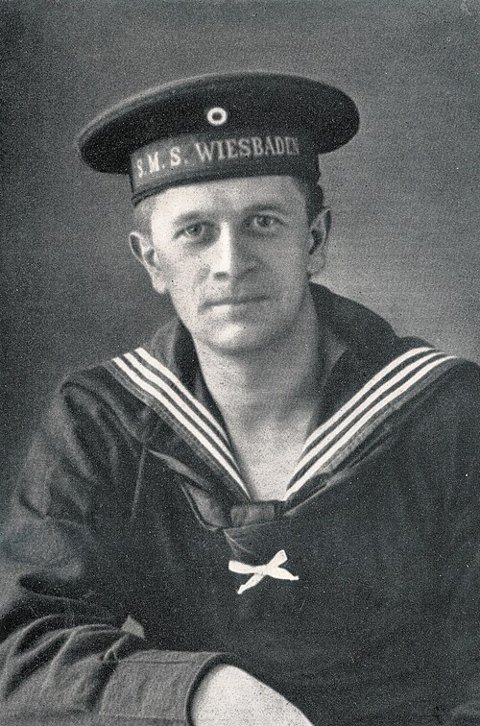
In the First World War, Kinau was drafted into the German infantry in 1915. He fought in Serbia and Russia and later at Verdun. From 1916 he served in the German Navy, having requested the transfer. He served as a lookout on the light cruiser SMS Wiesbaden and died when the ship was sunk in the Battle of Jutland. His body was found on the Swedish shore on the island Väderöbod midsummer's eve 1916 near Fjällbacka. He was later buried on the island of Stensholmen together with other German and British servicemen. He was recognised by carrying a poem, "Letzter Wunsch", which predicted his demise, in a hermetically sealed box in his pocket: