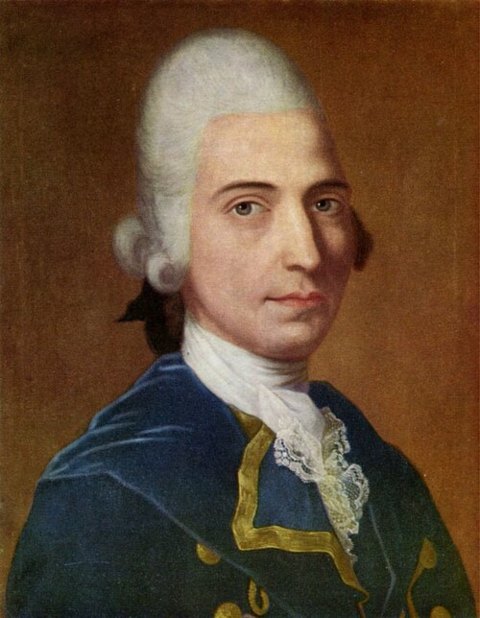
A Wikipédia ainda não tem um artigo sobre este autor nesta língua. Abaixo, o texto em inglês.
Gottfried August Bürger (31 December 1747 – 8 June 1794) was a German poet. His most notable ballad, Lenore, found an audience beyond readers of the German language in an English and Russian adaptation and a French translation.
Biography
Bürger was born in Molmerswende (now a part of Mansfeld), Principality of Halberstadt, where his father was the Lutheran pastor.
He showed an early predilection for solitary and gloomy places and the making of verses, for which he had no other model than hymnals. At the age of twelve, he was adopted by his maternal grandfather, Bauer, at Aschersleben, who sent him to the Pädagogium at Halle. He learned Latin with difficulty. In 1764, he gained admission into the University of Halle as a student of theology, which, however, he soon abandoned for the study of jurisprudence. There he fell under the influence of Christian Adolph Klotz (1738–1771), who directed Bürger's attention to literature. In consequence of his dissipated habits, in 1767 he was recalled by his grandfather, but on promising to reform, was allowed to enter the University of Göttingen as a law student in 1768.
As he continued his turbulent career, however, his grandfather withdrew his support and he was left to his own. Meanwhile, he had made fair progress with his legal studies, and formed a close friendship with a number of young men of literary tastes. He studied ancient classics and notable works in French, Italian, Spanish and English, particularly Shakespeare, and the old English and Scottish ballads. Thomas Percy's Reliques of Ancient English Poetry, which Bürger translated into German, was his constant companion. In the Göttingen Musenalmanach, edited by Heinrich Christian Boie and Friedrich Wilhelm Gotter, Bürger's first poems were published, and by 1771 he had already become widely known as a poet. In 1772, through Boie's influence, Bürger obtained the post of Amtmann or district magistrate at Altengleichen near Göttingen. His grandfather reconciled with him, paid his debts and established him in his new sphere of activity.