A Wikipédia ainda não tem um artigo sobre este autor nesta língua. Abaixo, o texto em inglês.
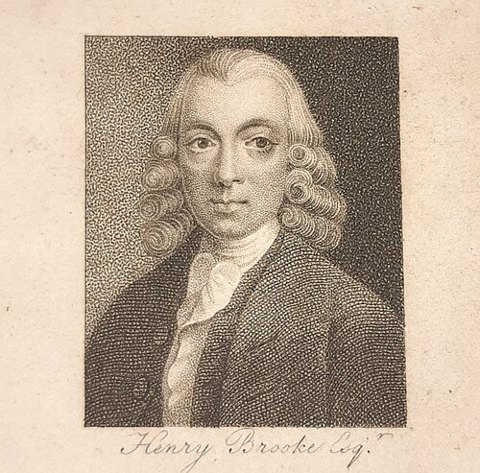
Henry Brooke (1703 – 10 October 1783) was an Irish novelist and dramatist. He was born and raised at Rantavan House near Mullagh, a village in the far south of County Cavan in Ireland, the son of a clergyman, and he later studied law at Trinity College, Dublin, but embraced literature as a career.
Life
Brooke's father was The Reverend William Brooke (1669–1745), a wealthy Church of Ireland rector of Killinkere and Mullagh within the Church of Ireland Diocese of Kilmore. His mother was Lettice Digby, daughter of Simon Digby, bishop of Elphin. He had two brothers. He matriculated into Trinity College in 1720. He left for London in 1724 to study law at the Temple, but returned to Ireland following the death of his maternal aunt, and his appointment as a guardian to his cousin, Catherine Meares (1712/13–1773). They later married in secret before 1728. Brooke returned to London to recommence his legal career and embark on a literary one.
His philosophical poem Universal Beauty was published in 1735, and Alexander Pope thought its sentiments and poetry fine. He then turned dramatist by adapting extant plays, such as The Earl of Essex. His Gustavus Vasa (1739) has the distinction of being the first play banned by the Licensing Act 1737. The play concerned the liberation of Sweden from Denmark in 1521 by Riksföreståndare (Protector of the Realm or Regent) Gustav Vasa (who later became King Gustav I of Sweden). Sir Robert Walpole believed that the villain of the play resembled him. Further, a facetious "attack" on it was the first public writing of Samuel Johnson, whose A Complete Vindication of the Licensers of the English Stage feigns support for Walpole while it drives the censor's argument to reductio ad absurdum.