A Wikipédia ainda não tem um artigo sobre este autor nesta língua. Abaixo, o texto em inglês.
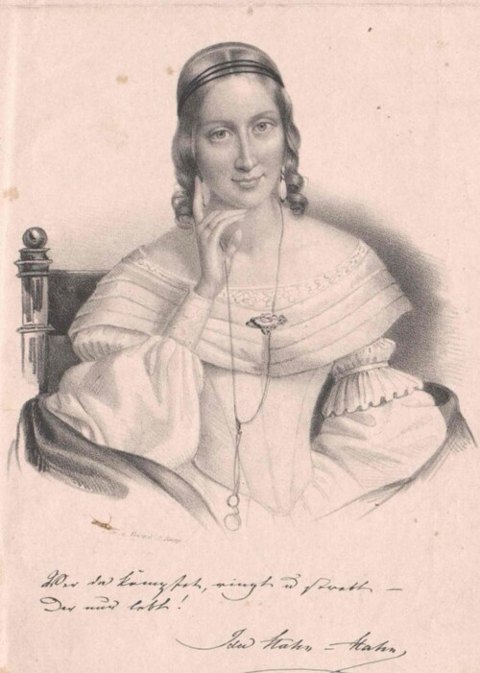
Countess Ida von Hahn-Hahn (German: Ida Gräfin von Hahn-Hahn; 22 June 1805 – 12 January 1880) was a German author from a wealthy family who lost their fortune because of her father's eccentric spending. She defied convention by living with Adolf von Bystram unmarried for 21 years. Her writings about the German aristocracy were greatly favored by the general public of her time. Ida von Hahn-Hahn often wrote about the tragedies of the soul and was influenced by the French novelist George Sand. She "was an indefatigable campaigner for the emancipation of women" and her writings include many strong female characters.
Biography
She was born at Tressow, in the duchy of Mecklenburg-Schwerin. She was the daughter of Count Karl von Hahn (1782 – 21 May 1857 Altona) of the von Hahn family, who was well known for his enthusiasm for stage productions, upon which he squandered a large portion of his fortune. In his old age, he was obliged to support himself by managing a provincial company and died in poverty.
In 1826, Ida married her wealthy cousin Friedrich Wilhelm Adolph Graf von Hahn, which gave her the doubled name. With him she had an extremely unhappy life, and in 1829 her husband's irregularities led to a divorce. She spent the years after her divorce ignoring social norms by traveling and living with Baron Adolf von Bystram. Bystram encouraged her to write about their travels across Europe and the Near East.
In 1847, the author drew upon herself the merciless ridicule of Fanny Lewald, who "attacked her as a self-indulgent aristocrat indifferent to the plight of the poor." After the revolutions of 1848 and the death of Adolf von Bystram in 1849, she embraced the Roman Catholic religion in 1850, after having opened the Bible on some day in 1849 and seeing this passage: "Arise, be enlightened O Jerusalem, for thy light is come, and the glory of the Lord is risen upon there." The countess Ida even visited the Prince Bishop Diepenbrock, of whom she asked whether or not she could be absorbed into the Catholic Church. Hahn-Hahn justified her step in a polemical work entitled Von Babylon nach Jerusalem (1851), which elicited a vigorous reply from Heinrich Abeken, and from several others as well.