A Wikipédia ainda não tem um artigo sobre este autor nesta língua. Abaixo, o texto em inglês.
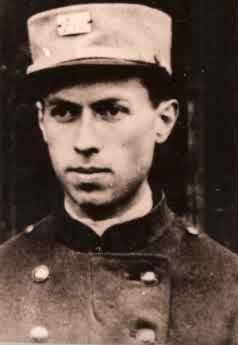
Jacques Rivière (French pronunciation: [ʒak ʁivjɛʁ]; 15 July 1886 – 14 February 1925) was a French "man of letters"—a writer, critic and editor who was "a major force in the intellectual life of France in the period immediately following World War I". He edited the magazine La Nouvelle Revue Française (NRF) from 1919 until his death. He was influential in winning a general public acceptance of Marcel Proust as an important writer. His friend and brother-in-law was Alain-Fournier (Henri Alban-Fournier), with whom he exchanged an abundant correspondence.
Biography
Rivière was born in Bordeaux, the son of an eminent physician. He became friends with Henri-Alban Fournier (later known as Alain-Fournier) at the Lycée Lakanal in Sceaux, Hauts-de-Seine. Both students prepared for the entrance examination for the École Normale Supérieure, and both failed. Rivière returned to Bordeaux in 1905, and from that date until Alban-Fournier's death in 1914 maintained a frequent correspondence with him.
Rivière obtained an arts degree in Bordeaux, performed his military service, and returned in 1907 to Paris. There he prepared a thesis at the Sorbonne on the Theodicy of Fénelon, while earning a living as a teacher at the Stanislas College. He was influenced by Maurice Barrès, André Gide and Paul Claudel, with whom he corresponded.
On 24 August 1909, Rivière married Isabelle Alban-Fournier, his friend Henri's younger sister. In 1913, he explicitly declared his Catholicism.
After writing for the literary revue L'Occident, Rivière became a sub-editor of the NRF in 1912. He also began to write literary criticism, which he collected and published with the title Études (Studies). The essays in this book reveal Rivière's excellent sense of psychology.