A Wikipédia ainda não tem um artigo sobre este autor nesta língua. Abaixo, o texto em inglês.
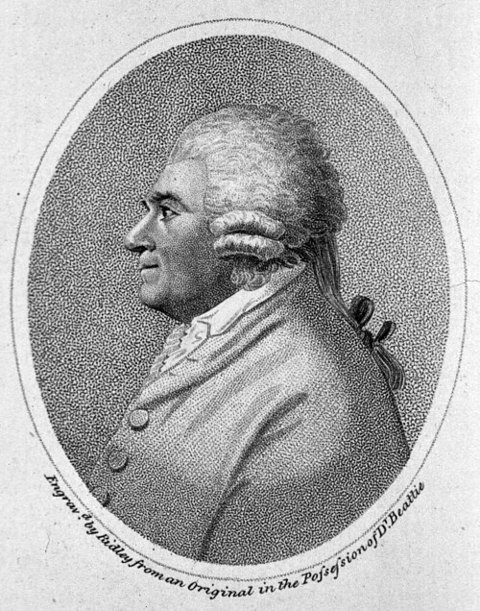
James Beattie (25 October 1735 – 18 August 1803) was a Scottish poet, moralist, and philosopher.
Career
He became the schoolmaster of the parish of Fordoun in 1753. He took the position of usher at the grammar school of Aberdeen in 1758.
In 1760, he was, to his surprise, appointed Professor of Moral Philosophy at Marischal College (later part of Aberdeen University) as a result of the influence exerted by his close friend, Robert Arbuthnot of Haddo. In the following year, he published a volume of poems, The Judgment of Paris (1765), which attracted attention. But the two works that brought him most fame were An Essay on the Nature and Immutability of Truth, and his poem of The Minstrel. The Essay, intended as an answer to David Hume, had great immediate success, and led to an introduction to the King, a pension of £200, and the degree of LL.D. from Oxford. The first book of The Minstrel was published in 1771 and the second in 1774, and constitutes his true title to remembrance, winning him the praise of Samuel Johnson. It contains much beautiful descriptive writing.
Beattie was prominent in arguing against the institution of slavery, notably in his Essay on the Nature and Immutability of Truth (1770), and in Elements of Moral Science (1790–93), where he used the case of Dido Belle to argue the mental capacity of black people.
Beattie was an amateur cellist and member of the Aberdeen Musical Society. He considered questions of music philosophy in his essay On Poetry and Music (written 1762, published 1776), which was republished several times and translated into French in 1798. His poem "The Hermit" was set to music by Tommaso Giordani (1778).