A Wikipédia ainda não tem um artigo sobre este autor nesta língua. Abaixo, o texto em inglês.
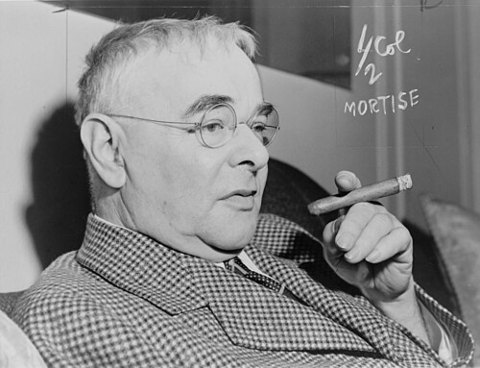
Joseph Hergesheimer (February 15, 1880 – April 25, 1954) was an American writer of the early 20th century known for his novels of decadent life among the wealthy.
Early life
Hergesheimer was born on February 15, 1880, in Philadelphia, Pennsylvania. He was often ill as a child and his only education was about three years of instruction at Germantown Friends School, a Quaker institution in Philadelphia. He briefly attended the Pennsylvania Academy of the Fine Arts. When Hergesheimer was 21, his grandfather died and left him an inheritance. He then traveled to Italy, where he lived as a painter in Venice. Having squandered his fortune, Hergesheimer was forced to return to America.
Career
Hergesheimer was unable to sell any of his writing in the first ten years of his career. Finally, in 1913, he sold a story to the Saturday Evening Post. He published his first novel, The Lay Anthony, in 1914. Three Black Pennys, which followed in 1917, chronicled the fictional lives of three generations of Pennsylvania ironmasters and cemented the author's style of dealing with upperclass characters through a floridly descriptive style he referred to as "aestheticism." Three Black Pennys was also the first original American novel published by the newly formed Alfred A. Knopf publishing house. Hergesheimer also received critical recognition for his novels Java Head (1919), Linda Condon (1919), and Balisand (1924).
Hergesheimer's reputation fluctuated wildly in his own lifetime, from a peak of acclaim and popularity in the 1920s to almost total obscurity by the time of his death. Java Head, a miscegenation story told from multiple viewpoints that is generally considered his best novel, was a considerable popular success, and his flamboyant, ornate, highly descriptive style (which can be seen to best effect in works like the travelogue San Cristobal de la Habana) was considered elegant and powerful. Hergesheimer's manner of writing, known at the time as the "aesthetic" school (in which he was frequently paired with James Branch Cabell), remained in demand throughout the 1920s (with F. Scott Fitzgerald's The Great Gatsby being the most durable example of a book written in this style). Sinclair Lewis's novel Babbitt includes an extensive passage in which the title character reads from Three Black Pennys. A 1922 poll of critics in Literary Digest voted Hergesheimer the "most important American writer" working at the time. Hergesheimer's works of long-form and short fiction sold well with both male and female readerships; a 1929 teaser in for an upcoming serialized story in Cosmopolitan, for example, called Hergesheimer a writer "who understands women better than any writer alive today." On the other hand, John Drinkwater wrote that "His constant complaint is that women readers, with their craving for sentimentality, are a blighting influence upon the American fiction of the age."