A Wikipédia ainda não tem um artigo sobre este autor nesta língua. Abaixo, o texto em inglês.
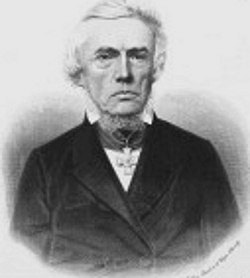
Johann Karl Friedrich Rosenkranz (German: [ˈʁoːzn̩kʁants]; April 23, 1805 – July 14, 1879) was a German philosopher and pedagogue.
Life
Born in Magdeburg, he read philosophy at Berlin, Halle and Heidelberg, devoting himself mainly to the doctrines of Hegel and Schleiermacher. After holding the chair of philosophy at Halle for two years, he became, in 1833, a professor at the University of Königsberg. In his last years, he was blind.
He died in Königsberg.
Philosophy
Throughout his long professorial career, and in all his numerous publications he remained, in spite of occasional deviations on particular points, loyal to the Hegelian tradition as a whole. In the great division of the Hegelian school, he, in company with Michelet and others, formed the "centre," midway between Erdmann and Gabler on the one hand, and the "extreme left" represented by Strauss, Feuerbach and Bruno Bauer.
Karl Rosenkranz was the editor-in-chief of Hegel's Collected Works, vols. 1–12 (1832–44). He published Hegel's Life (1844) as a supplement to these Works. He personally met Hegel and talked with him about philosophy. Rosenkranz had access to Hegel's manuscripts, letters, and the recollections of students, family members, and acquaintances.
Rosenkranz's writings on pedagogy were popular in translation among the St. Louis Hegelians. They appeared (translated by Anna Brackett) in multiple volumes of the Journal of Speculative Philosophy.