A Wikipédia ainda não tem um artigo sobre este autor nesta língua. Abaixo, o texto em inglês.
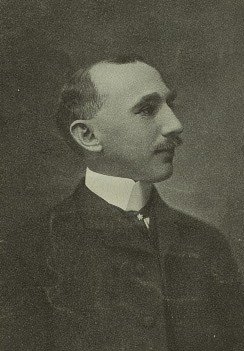
Madison Julius Cawein (March 23, 1865 – December 8, 1914) was a poet from Louisville, Kentucky.
Biography
Madison Julius Cawein was born in Louisville, Kentucky on March 23, 1865, the fifth child of William and Christiana (Stelsly) Cawein. His father made patent medicines from herbs. Thus as a child, Cawein became acquainted with and developed a love for local nature. Madison Cawein lived in Louisville his entire life, with the exception of three years spent in New Albany, Indiana, as a teenager.
After graduating from Louisville Male High School in 1886, Cawein worked in a pool hall in Louisville as a cashier in Waddill's New-market, which also served as a gambling house. He worked there for six years, saving his pay so he could return home to write.
His output was thirty-six books and 1,500 poems. His writing presented Kentucky scenes in a language echoing Percy Bysshe Shelley and John Keats. He soon earned the nickname the "Keats of Kentucky". He was popular enough that, by 1900, he told the Louisville Courier-Journal that his income from publishing poetry in magazines amounted to about $100 a month.
In 1912 Cawein was forced to sell his Old Louisville home, St. James Court (a 2+1⁄2-story brick house built in 1901, which he had purchased in 1907), as well as some of his library, after losing money in the 1912 stock market crash. In 1914, the Authors Club of New York City placed him on their relief list. He died on December 8, 1914, and was buried in Cave Hill Cemetery.
Influence
Cawein is acknowledged as the first Kentucky poet to earn a national reputation. In April 1913, the Louisville Literature Club unveiled a bronze bust of the poet by J. L. Roop to the Louisville Free Public Library. The public ceremony included letters of praise from Wilbur D. Nesbit, William Morton Payne, James Whitcomb Riley, and others. After his death at a young age, however, he was mostly forgotten until a more recent revival recognized the farsightedness of his writing.