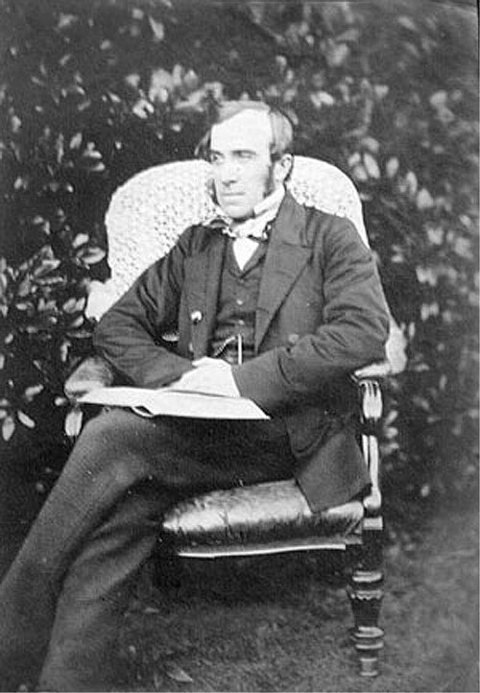
Autor
Monier Monier-Williams
1819–1899
- Nascimento
- 12 de novembro de 1819, Bombaim
- Morte
- 11 de abril de 1899, Cannes
- Nacionalidade
- Reino Unido da Grã-Bretanha e Irlanda
- Ocupação
- Linguista, indianista, tradutor, lexicógrafo e escritor
Vida e obra
A Wikipédia ainda não tem um artigo sobre este autor nesta língua. Abaixo, o texto em inglês.
Sir Monier Monier-Williams (né Williams; 12 November 1819 – 11 April 1899) was a British scholar who was the second Boden Professor of Sanskrit at Oxford University, England. He studied, documented and taught Asian languages, especially Sanskrit, Persian and Hindustani.
Early life and education
Monier Williams was born in Bombay, the son of Colonel Monier Williams, surveyor-general in the Bombay presidency. His surname was "Williams" until 1887, when he added his given name to his surname to create the hyphenated "Monier-Williams". In 1822, he was sent to England to be educated at private schools at Hove, Chelsea and Finchley. He was educated at King's College School, Balliol College, Oxford (1838–1840), the East India Company College (1840–1841) and University College, Oxford (1841–1844). He took a fourth-class honours degree in Literae Humaniores in 1844.
He married Julia Grantham, daughter of Rev. Francis Joseph Faithfull, in 1848. They had six sons and one daughter. He died, aged 79, in Cannes, France.
Career
Monier Williams taught Asian languages at the East India Company College from 1844 until 1858 when company rule in India ended after the 1857 rebellion. He came to national prominence during the 1860 election campaign for the Boden Chair of Sanskrit at Oxford University, in which he stood against Max Müller.
The vacancy followed the death of Horace Hayman Wilson in 1860. Wilson had started the university's collection of Sanskrit manuscripts upon taking the chair in 1831, and had indicated his preference that Williams should be his successor. The campaign was notoriously acrimonious. Müller was known for his liberal religious views and his philosophical speculations based on his reading of Vedic literature. Monier Williams was seen as a less brilliant scholar, but had a detailed practical knowledge of India itself, and of actual religious practices in modern Hinduism. Müller, in contrast, had never visited India.
Texto: “Monier Monier-Williams”, da Wikipédia, a enciclopédia livre, sob a licença CC BY-SA 4.0. Datas e fatos: Wikidata.
Acervo
Livros de Monier Monier-Williams
1 livro