A Wikipédia ainda não tem um artigo sobre este autor nesta língua. Abaixo, o texto em inglês.
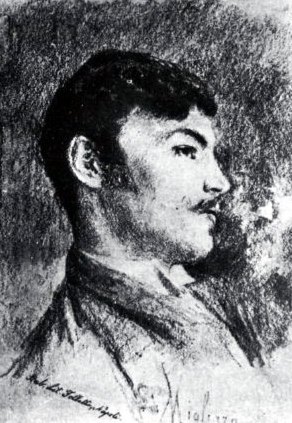
Salvatore Di Giacomo (12 March 1860 – 5 April 1934) was an Italian poet, songwriter, playwright and fascist, one of the signatories to the Manifesto of the Fascist Intellectuals.
Di Giacomo is credited as being one of those responsible for renewing Neapolitan language poetry at the beginning of the 20th century. The language of Salvatore Di Giacomo is, however, not the everyday Neapolitan language of his contemporaries; it has a distinct 18th-century flavour to it, with archaisms that recall the golden age of Neapolitan culture. This was the period between 1750 and 1800, when Neapolitan was the language of the Neapolitan comic opera.
Early career
Di Giacomo was born in Naples.
He studied medicine briefly, largely to satisfy his father's wishes, but gave it up to devote himself to literature. He first wrote short stories in the veristic manner (collected in 1893 in Pipa e boccale), but soon turned to poetry. He then founded a literary journal, Il Fantasio, in 1880, and, like many young writers, had a varied apprenticeship, working in a print shop, as a journalist and publishing some of his early verse in the Neapolitan daily, il Mattino. He even wrote a series of youthful stories à la E. T. A. Hoffmann and Edgar Allan Poe set in an imaginary German town inhabited by sinister students and mad doctors.
He had a lifelong love of libraries as well as literary and historical research, founding, in the course of his career, the Lucchese section of the National library in Naples and holding the position of assistant librarian at the library of the San Pietro a Maiella music conservatory. He was, with Benedetto Croce, one of the founders of the literary journal, Napoli Nobilissima. He was also an expert of the history of his land, and he published the work Per la storia del brigantaggio nel Napoletano in 1904. He received a critical boost in 1903 when Croce published a defence of dialect poetry. Di Giacomo published no anthology of his own collected poems until 1907, when he was 47 years old.