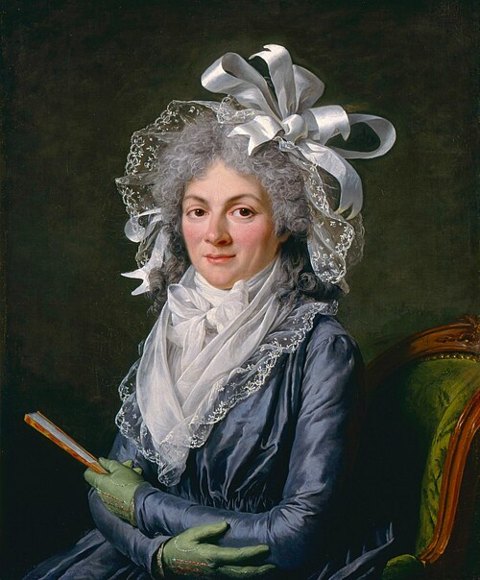
A Wikipédia ainda não tem um artigo sobre este autor nesta língua. Abaixo, o texto em inglês.
Caroline-Stéphanie-Félicité, Madame de Genlis (25 January 1746 – 31 December 1830) was a French writer of the late 18th and early 19th century, known for her novels and theories of children's education. She is now best remembered for her journals and the historical perspective they provide on her life and times.
Life
Caroline-Stéphanie-Félicité du Crest de Saint-Aubin was born on 25 April 1746 at Champcéry near Autun, in the Saône-et-Loire region. Her parents were Pierre César du Crest (1711–1763), later Marquis de Saint Aubin, and Marie Françoise Félicité Mauget de Mézières (1717–1790).
Her father's debts forced him to sell their home in 1757 and move to Paris. She and her mother spent interludes at the estates of Charles Guillaume Le Normant d'Étiolles and Alexandre Le Riche de La Poupelinière, where she was taught dancing by a ballet master of the Comédie-Française and singing by Ferdinando Pellegrini. She also learned to play the harp, a skill which later in Paris she used to support them. Pierre César was captured by the English while returning from Santo Domingo in 1760 and one of his fellow prisoners was Charles-Alexis Brûlart, Comte de Genlis (1737–1793), whom he introduced to his daughter after their release. After Pierre died in 1763, his sister married de Genlis at midnight on 8 November 1763; as a younger son, his title 'Comte' was complimentary and she was always known as Madame de Genlis.
In 1782 she published her first epistolary novel Adèle et Thèodore written while on holiday in Lusignano in Liguria. Its basic theme is education, where she takes a position unlike Rousseau in Emile. For her the condition of women depends on the education that is imparted to take the role that belongs to her in society, while for Jean-Jacques Rousseau the sphere of female action is restricted to the domestic sphere and therefore their education remains limited; for Genlis, education represents a step forward for her emancipation but on the other hand she submits first to the will of her mother and then of her husband. The success of this novel was due to the fact that she is the first woman to be gouverneur of princes of royal blood.