A Wikipédia ainda não tem um artigo sobre este autor nesta língua. Abaixo, o texto em inglês.
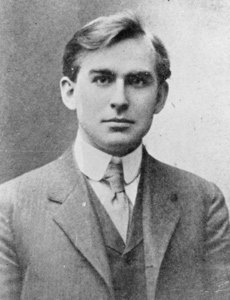
Tenney Frank (May 19, 1876 – April 3, 1939) was a prominent American ancient historian and classical scholar. He studied many aspects of Ancient Rome, for instance its economy, imperialism, demographics and epigraphy.
Biography
Tenney Frank earned his A.B. at the University of Kansas in 1898 and his A.M. the following year. Frank went on to receive his Ph.D. at the University of Chicago in 1903. Frank taught at Bryn Mawr College as a Professor of Latin from 1904 until 1919, when he moved to the Johns Hopkins University. At Bryn Mawr Frank wrote and published his influential study Roman Imperialism in 1914. Frank believed that Rome's imperialism stemmed from a desire to keep peace in the Mediterranean world by preventing the rise of any rival power. Frank's other work focused on classical literature, with articles on Cicero, Strabo, Curiatius Maternus, Plautus, and Virgil, among others. In 1932 he gave the British Academy's Master-Mind Lecture, on Cicero.
He wrote periodically for the American Historical Review, including a paper on the demise of the various ancient Italian peoples that comprised the Roman ethnicity in Julius Caesar's day. Arguing that Roman expansion brought in masses of foreign peoples and slaves that over time changed the ethnic make-up of the Roman populace and contributed to the empire's ruin.
He worked on Latin inscriptions, including the stele from the Forum Romanum in Rome, and on Roman construction and the Servian Wall of Rome. His work on the Roman economy was a seminal study of the economy and trade in the Roman world.