The Victory At Sea
Leitura online Ver livro
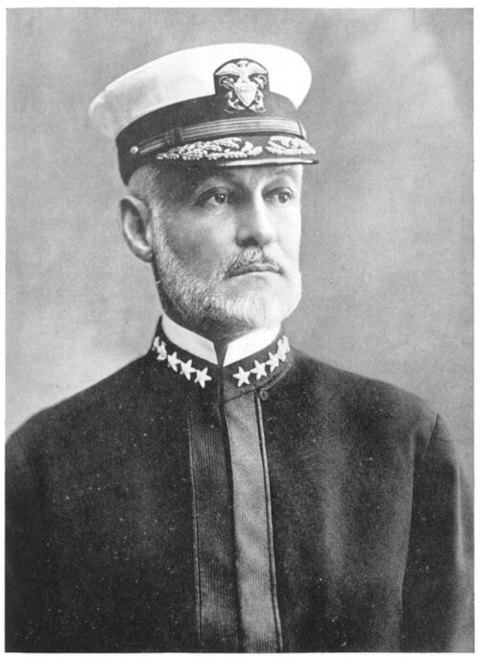
Autor
1858–1936
A Wikipédia ainda não tem um artigo sobre este autor nesta língua. Abaixo, o texto em inglês.
William Sowden Sims (October 15, 1858 – September 28, 1936) was an admiral in the United States Navy who fought during the late 19th and early 20th centuries to modernize the navy. During World War I, he commanded all United States naval forces operating in Europe. He also served twice as president of the Naval War College.
Sims was born to American father Alfred William (1826–1895) and Canadian mother Adelaide (née Sowden; b. 1835) living in Port Hope, Canada West. He graduated from the United States Naval Academy in 1880, the beginnings of an era of naval reform and greater professionalization. Commodore Stephen B. Luce founded the Naval War College in Newport, Rhode Island in 1884, to be the service's professional school. During the same era, Naval War College instructor Captain Alfred Thayer Mahan was writing influential books on naval strategy and sea power.
In March 1897, shortly after his promotion to lieutenant, Sims was assigned as the military attaché to Paris and St. Petersburg. In this position he became aware of naval technology developments in Europe as well gaining familiarity with European politics which would greatly assist him during World War I. He was in this assignment during the Spanish–American War during which Sims was able to use his diplomatic connections to gain information on Spain and its high-ranking officials.
As a young officer, Sims sought to improve naval gunnery. In the recently concluded war with Spain, American warships had fired 9,500 shells, of which only 121 found their mark. Sims sought to improve on this by employing a technique about which he had learned from Percy Scott of the British navy. The technique, continuous-aim firing, called for a gunner to adjust the gun's aim throughout the roll of the ship on which the gun is mounted, thereby keeping the gun constantly trained on the target throughout the roll, rather than keeping the gun in a fixed position and waiting for the roll to align the gun with the target. Scott had reportedly achieved a hit-rate of 80% using the new method. Sims advocated the same method for the U.S. Navy, but his superiors resisted his suggestions, partly because Sims was of low rank, and partly because of Sims's outspoken, rebellious attitude. In 1902, Sims wrote directly to President Theodore Roosevelt. The president, who had previously served as Assistant Secretary of the Navy, was intrigued by Sims's ideas and made him the Navy's Inspector of Naval Gunnery on November 5, 1902, shortly after which Sims was promoted to lieutenant commander. He was promoted to commander in 1907.
Texto: “William Sims”, da Wikipédia, a enciclopédia livre, sob a licença CC BY-SA 4.0. Datas e fatos: Wikidata.
Acervo
1 livro