Wikipedia aún no tiene un artículo sobre este autor en este idioma. A continuación, el texto en inglés.
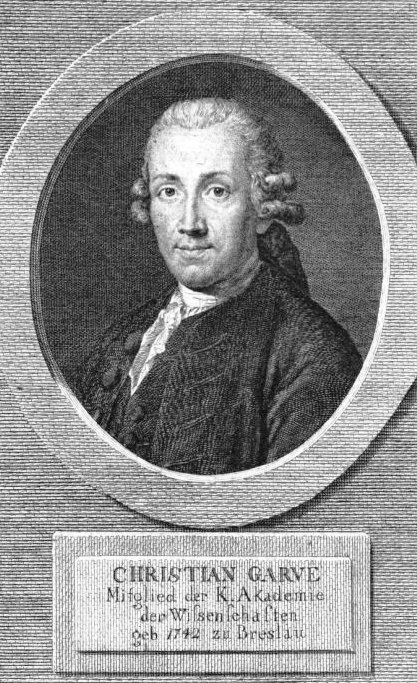
Christian Garve (German: [ˈɡaʁvə]; 7 January 1742 – 1 December 1798) was one of the best-known philosophers of the late Enlightenment along with Immanuel Kant and Moses Mendelssohn.
Life
Christian Garve was born into a family of manual workers and died aged 56 in his parental home. He studied in Frankfurt an der Oder and Halle (Saale). In 1766 he gained his master's degree in philosophy. From 1770 until 1772 he was extraordinary professor of mathematics and logic in Leipzig. He retired to Breslau in 1772 due to bad health, where he was active as a bookseller. The greatest part of his life was however spent staying with his mother in Breslau. In this city he also became a member of the Masonic Lodge "Friedrich zum goldenen Zepter" ("Frederick of the Golden Scepter").
Garve became well-known particularly for his intensive activity as a translator (producing versions of, e.g., Cicero's De Officiis (1783) and Adam Smith's Wealth of Nations). His translation of Cicero's work was done at the request of Frederick II, who bestowed upon him a pension of 200 thalers. Garve eulogized Frederick in the Fragmente zur Schilderung des Geistes, Charakters and der Regierung Friedrichs II. (1798).
He composed psychological, moral and economic texts and reviews for the Neue Bibliothek der schönen Wissenschaften und der freyen Künste ("New Library of the Beautiful Sciences and Free Arts"). He was strongly marked by the influence of the English and Scottish Enlightenment as well as Stoic ethics. He never formulated his essentially empirical philosophy in terms of a system, publishing his thought in the form of remarks and essays. As a result, he was reproached for being merely a shallow Popularphilosoph (popular philosopher), a reputation he has retained, and his writings did much toward the popularization of philosophy in Germany.