Wikipedia aún no tiene un artículo sobre este autor en este idioma. A continuación, el texto en inglés.
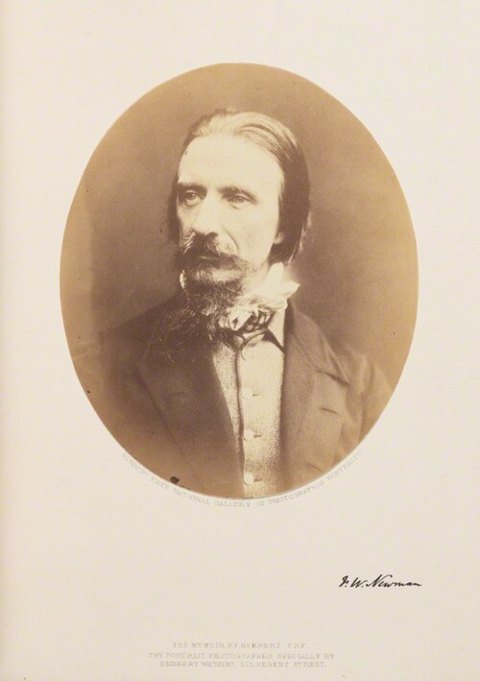
Francis William Newman (27 June 1805 – 4 October 1897) was an English classical scholar and moral philosopher, prolific miscellaneous writer and activist for vegetarianism and other causes.
He was the younger brother of John Henry Newman. Thomas Carlyle in his life of John Sterling called him a "man of fine attainments, of the sharpest-cutting and most restlessly advancing intellect and of the mildest pious enthusiasm." George Eliot called him "our blessed St. Francis" and his soul "a blessed yea".
Early life
Newman was born in London, the third son of John Newman, a banker, and his wife Jemima Fourdrinier, sister of Henry Fourdrinier. With his brother John Henry, he was educated at Ealing School. He matriculated at Worcester College, Oxford in 1822, where he obtained a double first class and graduated B.A. in 1826. He was elected fellow of Balliol College in the same year.
During his undergraduate days, his father's bank having failed, he was able to complete his degree by relying on financial support from his older brother John Henry. Early in his student period, however, lodging as he did with his brother, he disagreed enough on established religion to feel, at least as he expressed it in a late autobiographical work, that there was a breach in their relationship. He never graduated M.A., normally at Oxford a pure formality, since he shortly acquired religious scruples about signing as required the 39 Articles.
In 1827, Newman went to Delgany, County Wicklow, where for a year he tutored the sons of Edward Pennefather, There he fell under the influence of Pennefather's brother-in-law, the Rev John Nelson Darby, one of the nascent group of Plymouth Brethren, who he describes in Phases of Faith as "the Irish Clergyman".