Wikipedia aún no tiene un artículo sobre este autor en este idioma. A continuación, el texto en inglés.
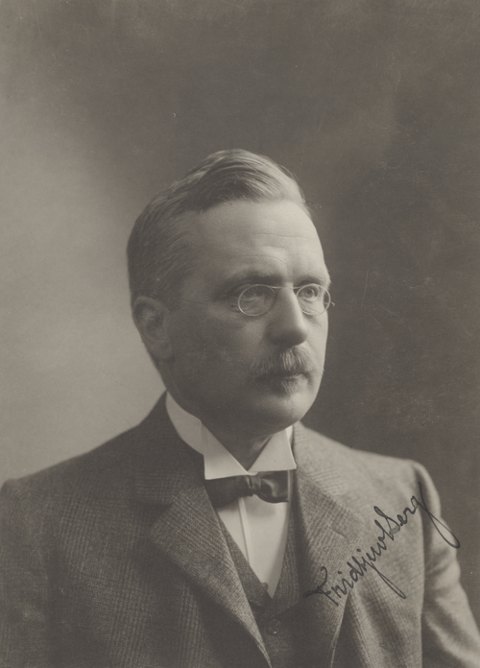
Johan Fridtjuv Berg (20 March 1851 – 29 February 1916) was a Swedish school teacher, author, and politician (liberal); he was minister of education and ecclesiastical affairs from 1905 to 1906 and 1911 to 1914 and Member of Parliament from 1891 to 1916. Berg was the son of educator Anders Berg and father of historian Tor Berg and artist Yngve Berg.
Biography
Johan Fridtjuv Berg was born 20 March 1851 in Ödeshögs parish, Östergötland county, Sweden. Berg's father had been a principal at a school in Finspång since 1851. Berg succeeded him in 1878 and remained in the post until 1881. In 1883, Berg wrote the book Folkskolan såsom bottenskola ('The Folk School as a Basic School') in which he advocated a school system where there was only one type of school for all social classes. Berg was a Member of Parliament (Riksdag) in the second chamber for the city of Stockholm from 1891 to 1911 and for Stockholm's first constituency from 1912 to 1916. In parliament, he belonged to the Gamla lantmannapartiet ('Old Party of the Rural People') from 1891 to 1894, but in 1895 he helped to form the People's Party (Folkpartiet), which in 1900 merged into the Liberal Coalition Party (Liberala samlingspartiet). Having previously spoken out only on educational and general humanitarian issues, he began to take an active part in political struggles in 1905. After the dissolution of the Union between Norway and Sweden, he spoke out firmly against any violent intervention in the conflict between. As a result, he was opposed by the right and some right-liberals in the 1905 autumn elections.