Wikipedia aún no tiene un artículo sobre este autor en este idioma. A continuación, el texto en inglés.
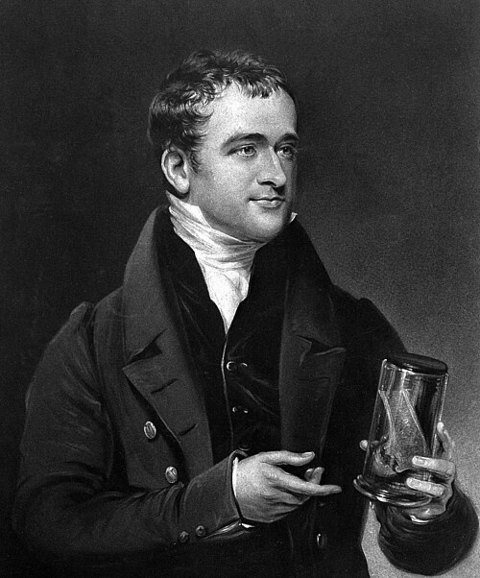
Herbert Mayo, M.D. (3 April 1796 – 28 June 1852), was a British physiologist, anatomist and medical writer.
Biography
Mayo was born in Queen Anne Street, London, the third son of John Mayo. He entered Middlesex Hospital as a surgical pupil on 17 May 1814, and was a pupil of Sir Charles Bell (1812–15). He also studied at the Leyden University, where he graduated with a D.M. degree. He became house-surgeon at Middlesex Hospital in 1818, and M.R.C.S. in 1819.
In August 1822, the first part of the Anatomical and Physiological Commentaries appeared, a work containing Mayo's assertion of his discovery of the real function of the nerves of the face, and his account of the experiments which proved it. This was the starting point of a bitter and prolonged controversy with Sir Charles Bell, the discoverer of the distinction between sensory and motor nerves. Dr. Whewell, in a letter to the London Medical Gazette dated 11 December 1837, describes the discovery as having been made by Bell, Mayo, and Majendie, the two latter physiologists having corrected and completed the researches of the former. His claim was elaborated by Dr. Druitt:
Mayo was the first in enunciating the positive doctrine that the portio dura is the nerve of voluntary motion for the face, and the fifth nerve, the nerve of common sensation to the same. It is true there are certain passages in Sir Charles Bell's treatise in 1821 which make it difficult to conceive how he could have missed the truth, whilst there are other passages which show positively that he did miss it. Meanwhile Mayo's statement and claim in 1822 were clear, precise, and unmistakable