Autor
R. W. Church
1815–1890
- Nacimiento
- 25 de abril de 1815, Lisboa
- Muerte
- 6 de diciembre de 1890, Dover
- Nacionalidad
- Reino Unido de Gran Bretaña e Irlanda y Reino de Portugal
- Ocupación
- Historiador, teólogo, escritor, ministro anglicano y lexicógrafo
Vida y obra
Wikipedia aún no tiene un artículo sobre este autor en este idioma. A continuación, el texto en inglés.
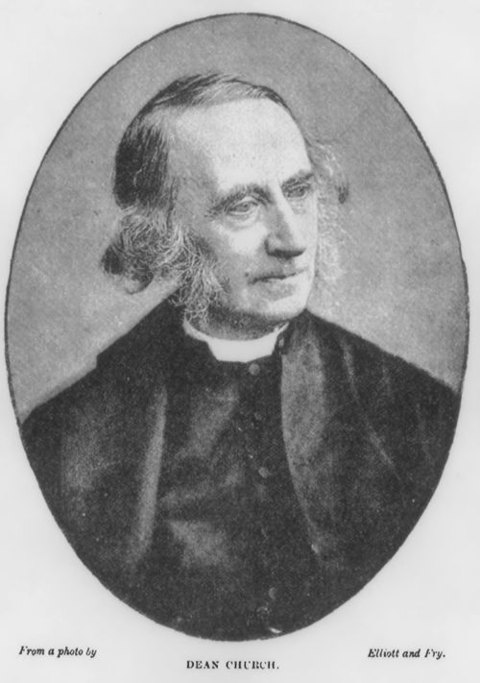
Richard William Church (25 April 1815 – 9 December 1890) was an English cleric and writer, known latterly as Dean Church. He was a close friend of John Henry Newman and allied with the Tractarian movement. Later he moved from Oxford academic life to some prominence in the Church of England.
Life
Richard William was the eldest of three sons of John Dearman Church, a wine merchant, and his wife Bromley Caroline Metzener (died 1845). His grandfather Matthew Church, a merchant of Cork, and his wife, were Quakers, and John was not baptised into the Church of England until his marriage in 1814. His uncle, General Sir Richard Church (1784–1873), achieved fame as a liberator of Greece.
The family moved in 1818 to Florence. After his father's death in 1828, his mother settled in Bath and he was sent to a strict evangelical school at Redland, Bristol. He was admitted in 1832 to Wadham College, Oxford, and took first-class honours in 1836. His mother, meanwhile, was remarried to Thomas Crokat, a widowed Englishman of Leghorn.
In 1838, Church was elected fellow of Oriel College. One of his contemporaries, Richard Mitchell, commented on his election: "There is such a moral beauty about Church that they could not help taking him." He was appointed a tutor of Oriel in 1839 and ordained the same year. He was a close friend of John Henry Newman in this period and allied to the Tractarian movement. In 1841, Tract 90 of Tracts for the Times appeared and Church resigned his tutorship.
From 1844 to 1845, Church was a junior proctor, and in that capacity and in concert with his senior colleague, vetoed a proposal to censure Tracts publicly. In 1846, with others, he started The Guardian newspaper and he was an early contributor to The Saturday Review. In 1850, he became engaged to H. F. Bennett, of a Somersetshire family, a niece of George Moberly, Bishop of Salisbury. After again holding the tutorship of Oriel, he accepted in 1858 the small living of Whatley in Somerset near Frome and was married the following year. He was said to be a diligent parish priest and a serious student, who contributed largely to current literature.
Texto: “Richard William Church”, de Wikipedia, la enciclopedia libre, bajo la licencia CC BY-SA 4.0. Fechas y datos: Wikidata.
Acervo
Libros de R. W. Church
2 libros