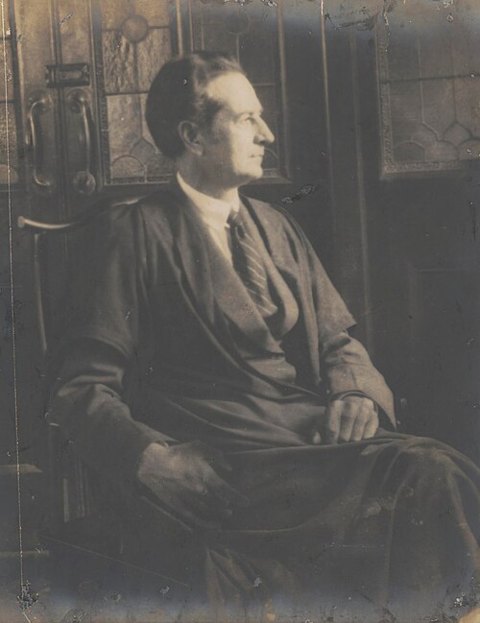
Alfred Reginald Radcliffe-Brown (né Brown; 17 January 1881 – 24 October 1955) was an English social anthropologist who helped develop the theory of structural functionalism. He performed fieldwork in the Andaman Islands and Western Australia, which became the basis of his later books. He had academic appointments at universities in Cape Town, Sydney, Chicago, and Oxford, and sought to model the topic of anthropology after the natural sciences.
Biography
Alfred Reginald Radcliffe-Brown was born Alfred Reginald Brown in Sparkbrook, Birmingham, England, the second son of Alfred Brown (d.1886), a manufacturer's clerk, and Hannah Brown (née Radcliffe). He later changed his surname, by deed poll, to Radcliffe-Brown, Radcliffe being his mother's maiden name. He was educated at King Edward's School, Birmingham, and Trinity College, Cambridge (B.A., 1905; M.A., 1909), graduating with first-class honours in the moral sciences tripos. At Trinity College, he was elected Anthony Wilkin student in 1906 and 1909. While still a student, he earned the nickname "Anarchy Brown" for his close interest in the writings of the anarcho-communist and scientist Peter Kropotkin.
Like other young men with blood in their veins, I wanted to do something to reform the world – to get rid of poverty and war, and so on. So I read Godwin, Proudhon, Marx and innumerable others. Kropotkin, revolutionary, but still a scientist, pointed out how important for any attempt to improve society was a scientific understanding of it.