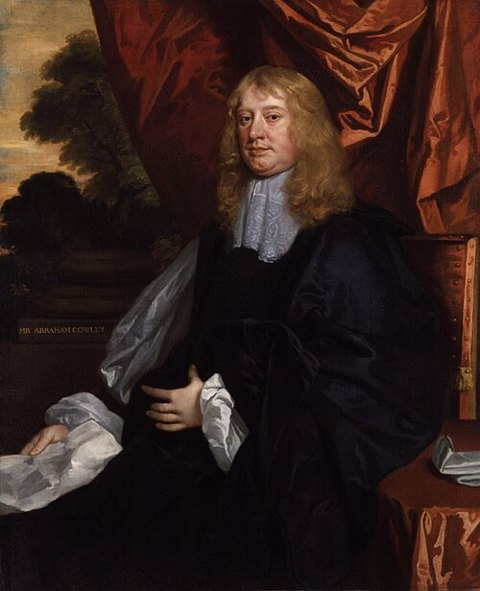
Abraham Cowley (1618 – 28 July 1667) was an English poet and essayist born in the City of London late in 1618. He was one of the leading English poets of the 17th century, with 14 printings of his Works published between 1668 and 1721.
Early life and career
Cowley's father, a wealthy Londoner, who died shortly before his birth, was a stationer. His mother was wholly given to works of devotion, but it happened that there lay in her parlour a copy of The Faerie Queene. This became the favourite reading of her son, and he had read it twice before he was sent to school.
As early as 1628, when he was only ten years old, he composed his Tragicall Historie of Piramus and Thisbe, an epic romance written in a six-line stanza, a style of his own invention. It has been considered to be a most astonishing feat of imaginative precocity; it is marked by no great faults of immaturity, and possesses constructive merits of a very high order. Two years later, Cowley wrote another and still more ambitious poem, Constantia and Philetus; around this time he was sent to Westminster School. At Westminster he displayed extraordinary mental precocity and versatility, writing when he was just thirteen the Elegy on the Death of Dudley, Lord Carlton. These three lengthy poems, and some smaller ones, were collected in 1633, and published in a volume entitled Poeticall Blossomes, dedicated to Lambert Osbaldeston, the headmaster of the school, and prefaced by many laudatory verses by schoolfellows.
Cowley at once became famous, although he was only fifteen years old. His next composition was a pastoral comedy, entitled Loves Riddle, a marvellous production for a boy of sixteen, airy, correct and harmonious in language, and rapid in movement. The style is not without resemblance to that of the poet Thomas Randolph, whose earliest works had only just been printed.