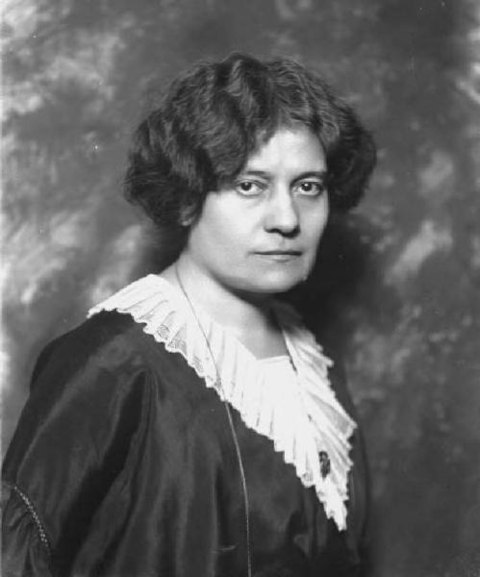
Ada Negri (3 February 1870 – 11 January 1945) was an Italian poet and writer. She was the only woman to be admitted to the Academy of Italy.
Biography
Ada Negri was born in Lodi, Italy on 3 February 1870. Her father, Giuseppe Negri, was a coachman, and her mother, Vittoria Cornalba, was a weaver.
After her father's death in 1871, Negri's childhood was characterized by her relationship with her grandmother, Giuseppina "Peppina" Panni.[1][2] Panni worked as a caretaker at the noble Barni family's palace, in which Negri spent much time alone, observing the passage of people as described in the autobiographical novel Stella Mattutina (1921).
She attended Lodi’s normal school for girls and earned an elementary teacher’s diploma. At eighteen, she became a schoolteacher in the village of Motta Visconti near the Ticino river, in Pavia. In her spare time, Negri would write poetry and submit it to local newspapers. Her early work appeared in the Milanese periodical L'Illustrazione Popolare. She was encouraged to continue her education by her teacher Paolo Tedeschi, who recognized her precocity and talent. Negri's inaugural volume of poetry, Fatalità (1892), was well received by readers and critics, earning her the "Giannina Milli" prize which provided Negri with a small stipend.[3] These accomplishments led to an appointment as a professor at the normal school in Milan. Here she became engaged to the young socialist intellectual Ettore Patrizi and met members of the Italian Socialist Party, including Filippo Turati, Benito Mussolini, and Anna Kuliscioff. Her second book of poems, Tempeste (1896), was published the same year Negri broke off her engagement to Patrizi. The book contains reflections on heartbreak and a continued focus on social inequity.