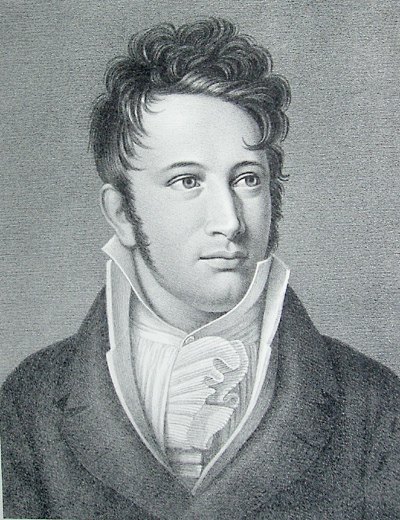
Adam Gottlob Oehlenschläger (Danish pronunciation: [ˈɛːtɑm ˈkʌtlʌp ˈøˀənˌslɛːjɐ]; 14 November 1779 – 20 January 1850) was a Danish poet and playwright. He introduced romanticism into Danish literature. He wrote the lyrics to the song Der er et yndigt land, which is the national anthem of Denmark.
Biography
He was born in Vesterbro, then a suburb of Copenhagen. His father, Joachim Conrad Oehlenschläger (1748–1827) was at that time organist of Frederiksberg Church and later, keeper of the royal palace of Frederiksberg. The poet's mother Martha Marie Hansen (1745–1800) suffered from depression, which afterwards deepened into melancholy madness.
Oehlenschläger and his sister Sophie Ørsted (1782–1818) were taught only to read and write, until their twelfth year. At the age of nine, Oehlenschläger began to write fluent verses. Three years later, he attracted the notice of the poet Edvard Storm (1749–1794) and as a result Oehlenschläger received an introduction into Scandinavian mythology.
Oehlenschläger was confirmed in 1795, and was to have been apprenticed to a tradesman in Copenhagen. He also entered the stage where he was offered a small position. In 1797 he made his appearance on the boards in several successive parts, but soon discovered that he possessed no real histrionic talent. Jurist Anders Sandøe Ørsted (1778–1860) who would later marry his sister Sophie, persuaded him to quit the theatre, and in 1800 he entered the University of Copenhagen. He was disturbed in his studies by the death of his mother, by his inveterate occupation with poetry, and finally by the First Battle of Copenhagen in April 1801, which, however, inspired a dramatic sketch (April the Second 1801), the first work of the kind by his pen that we possess.