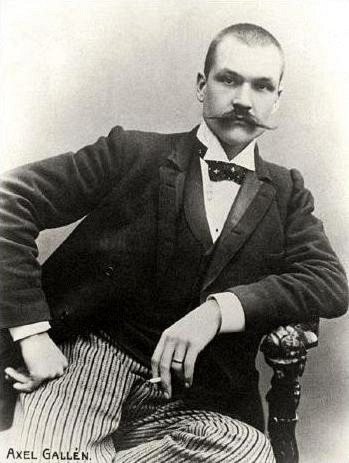
Akseli Gallen-Kallela (born Axel Waldemar Gallén; 26 April 1865 – 7 March 1931) was a Finnish painter and a leading figure of Finnish romantic nationalism around the turn of the 20th century. He is considered a pioneer of a distinctly Finnish national art, and his work is regarded as a very important aspect of Finnish national identity.
Gallen-Kallela began his career as a realist painter influenced by Jules Bastien-Lepage before turning, in the 1890s, towards symbolism and a stylised national-romantic idiom. He is best known for his depictions of the Kalevala, the Finnish national epic, including The Defense of the Sampo, Lemminkäinen's Mother and the Aino Triptych, as well as for his illustrations to the Kalevala and to Aleksis Kivi's novel Seven Brothers. He was also active as a graphic artist, designer and fresco painter, executing monumental works for the Finnish pavilion at the Paris World Fair of 1900 and the Jusélius Mausoleum in Pori. He finnicized his name from Gallén to Gallen-Kallela in 1907.