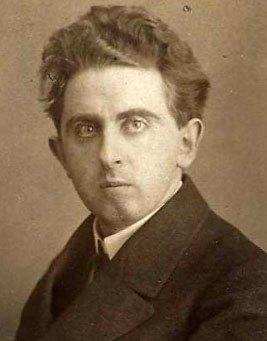
Albert Ehrenstein (23 December 1886 – 8 April 1950) was an Austrian-born German Expressionist poet. His poetry exemplifies the rejection of bourgeois values and fascination with the Orient, particularly with China.
He spent most of his life in Berlin, but also travelled widely across Europe, Africa, and the Far East. In 1930, he travelled to Palestine, and published his impressions in a series of articles. Shortly before the Nazi take-over, Ehrenstein moved to Switzerland, and in 1941 to New York City, where he lived until his death.
Early life
Ehrenstein was born to Jewish-Hungarian parents in Ottakring, Vienna. His father was a cashier at a brewery and the family was poor. His younger brother was the poet Carl Ehrenstein (1892–1971). His mother was able to enroll Ehrenstein in high school, where he was harassed with anti-semitic bullying. From 1905 to 1910 he studied history and philosophy in Vienna and graduated in 1910 with a doctorate (with a thesis on Hungary in 1790). He had already decided on a career of literature, which he described as: "Hardly university studies; but by five years of alleged studies, I secured liberty: Time to do poetic work. Through tolerant overhearing directed to me by mail and offended about to light I put on even a doctorate."
Poetry and writing
In 1910 he wrote the poem "Wanderers song" published by Karl Kraus in the Overnight Torch. The poem is attributed to the early expressionism and was published in 1911 with illustrations by his friend Oskar Kokoschka. Through Kokoschka he came into contact with Herwarth Walden and got it published in Der Sturm, and later in Franz Pfemfert's magazine Die Aktion. Ehrenstein quickly became one of the most important voices of expressionism and came into close contact with Else Lasker-Schüler, Gottfried Benn and Franz Werfel. It was widely circulated and Anton Kuh Spottvers wrote about it: "its a high honor of a work, only its verses disturb you."