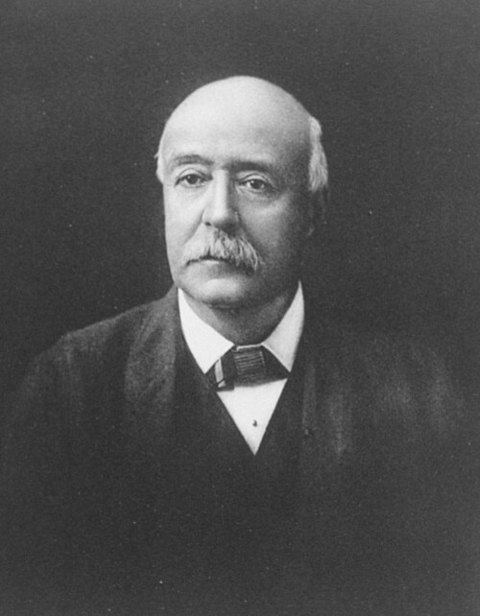
Author
Alexander Agassiz
Swiss-American zoologist and engineer (1835-1910)
- Born
- December 17, 1835, Neuchâtel
- Died
- March 27, 1910, RMS Adriatic
- Nationality
- United States and Switzerland
- Occupation
- Engineer, naturalist, zoologist, university teacher and curator
Life and work
Alexander Emmanuel Rodolphe Agassiz (December 17, 1835 – March 27, 1910), was an American scientist and engineer. He was the son of Louis Agassiz and stepson of Elizabeth Cabot Agassiz.
Biography
Agassiz was born in Neuchâtel, Switzerland, and immigrated to the United States in 1849, joining his father Louis Agassiz, after his mother Cecile (Braun) Agassiz died in 1848. Thereupon, his father enrolled him in the Cambridge High School, before entering Harvard at the age of 15. He graduated from Harvard University in 1855, subsequently studying engineering and chemistry, and taking the degree of Bachelor of Science at the Lawrence Scientific School of the same institution in 1857; in 1859 became an assistant in the United States Coast Survey, onboard the Fauntleroy. In 1860, he became an agent for the Museum of Comparative Zoology, and married Anna Russell.
Thenceforward he became a specialist in marine ichthyology. Agassiz was elected a Fellow of the American Academy of Arts and Sciences in 1862. Up until the summer of 1866, Agassiz worked as assistant curator in the museum of natural history that his father founded at Harvard.
E. J. Hulbert persuaded Agassiz's brother-in-law, Quincy Adams Shaw, and friends to invest in a rich copper lode discovered on Michigan's Keweenaw Peninsula, called the Calumet Mine. In 1866, Agassiz visited the outcrop and noted that the Calumet Conglomerate was a porphyry almost fourteen feet wide, dipping to the northwest at a 35 degree angle. The rich nature of the deposit convinced Shaw to purchase the land to the south, forming the Hecla Mining Company. Agassiz was then made treasurer of both companies. Disappointed in Hulbert's management of the Calumet, Agassiz replaced Hulbert with a new manager called Davis in December. Agassiz states, "I have put in every cent of mine into these two mines." Convinced the deposit could be developed at a profit, Agassiz was made superintendent of both mines, and arrived on site in March 1867. Upon arrival, Agassiz noted that Hulbert earlier that year was "...concealing the true nature of things and making estimates out of all proportion with what he must have known the expenses to be." One of the first projects Agassiz undertook was to change the openings of both mines so "the rock could be extracted with legitimate mining methods." With further investment from John Simpkins, improvements were made to the mills and almost 5 miles of railroad. In July, Agassiz's family joined him. By September 1868, Hecla was producing 185 tons of ingot, the Calumet 140, and both mills stamping 4000 tons of rock per month. Agassiz was able to place George Hardie in charge, and returned to Cambridge in October. Agassiz continued to visit the mines every spring and fall.
Text: “Alexander Agassiz”, from Wikipedia, the free encyclopedia, under the license CC BY-SA 4.0. Dates and facts: Wikidata.
Collection
Books by Alexander Agassiz
1 book