Life and work
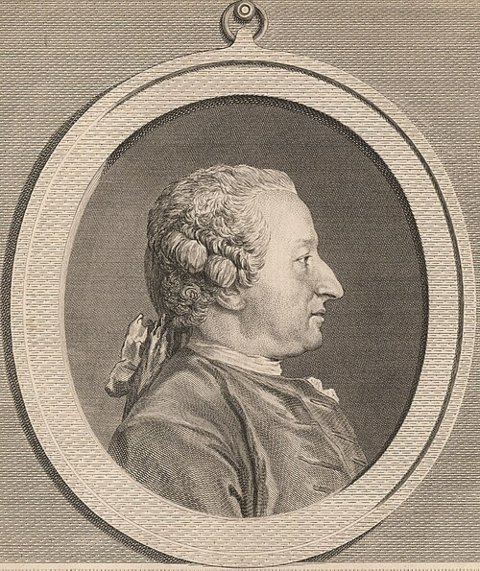
Alexis Claude Clairaut (French: [alɛksi klod klɛʁo]; 13 May 1713 – 17 May 1765) was a French mathematician, astronomer, and physicist. He was a prominent Newtonian whose work helped to establish the validity of the principles and results that Sir Isaac Newton had outlined in the Principia of 1687. Clairaut was one of the key figures in the expedition to the Lapland that helped to confirm Newton's deduction of the figure of the Earth. In that context, Clairaut deduced what is now known as Clairaut's theorem. He also tackled the gravitational three-body problem, being the first to obtain a satisfactory result for the apsidal precession of the Moon's orbit. In mathematics he is also credited with Clairaut's theorem on mixed partial derivatives, Clairaut's equation, and Clairaut's relation in differential geometry.
Text: “Alexis Clairaut”, from Wikipedia, the free encyclopedia, under the license CC BY-SA 4.0. Dates and facts: Wikidata.