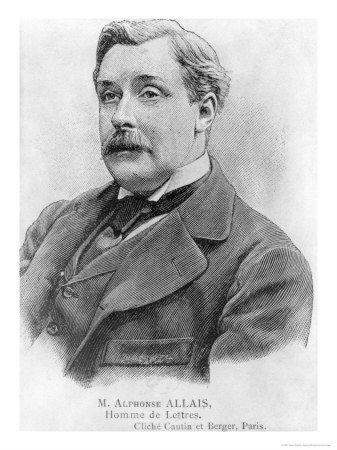
Alphonse Allais (20 October 1854 – 28 October 1905) was a French writer, journalist and humorist. He was also the editor of the Chat Noir, a satirical magazine.
Life
From 1879, Alphonse Allais attended the ″Hydropathic Society″ of Émile Goudeau, from which the school of fumism grew. Evidence (and the crowning glory) of Alphonse Allais's first literary successes was the January 1880 issue of the newspaper ″Hydropat″ entirely dedicated to him, with a caricature on the entire cover. It depicted a blond pharmacist, Alphonse Allais.
Already in the first year of Fumism, Paul Vivien wrote in his "leading" article:
...Alphonse Allais, head of the Fumist School, is one of the most famous and beloved characters of the Latin Quarter, where he has long been known for his wonderful gaiety and sharp wit...
Work
He is the author of many collections of whimsical writings. A poet as much as a humorist, he cultivated the verse form known as holorhyme (all verses are homophonous, where entire lines are pronounced the same). For example:
Par les bois du djinn où s'entasse de l'effroi,
Parle et bois du gin, ou cent tasses de lait froid.
Allais wrote the earliest known example of a completely silent musical composition. His Funeral March for the Obsequies of a Great Deaf Man of 1897 consists of 24 blank measures. It predates similarly silent but intellectually serious works by John Cage and Erwin Schulhoff by many years. His prose piece "Story for Sara" was translated and illustrated by Edward Gorey.
Allais participated in humorous exhibitions, including those of the Salon des Arts Incohérents of 1883 and 1884, held at the Galerie Vivienne. At these, inspired by his friend Paul Bilhaud's 1882 exhibit of an entirely black painting entitled "Negroes fight in a tunnel" (which he later reproduced with a slightly different title), Allais exhibited arguably some of the earliest examples of monochrome painting: for instance his plain white sheet of Bristol paper Première communion de jeunes filles chlorotiques par un temps de neige (First Communion of Anemic Young Girls In The Snow) (1883), and a similar red work Apoplectic Cardinals Harvesting Tomatoes on the Shore of the Red Sea (Aurora Borealis Effect) (1884). Allais published his Album primo-avrilesque in 1897, a monograph with seven monochrome artworks, accompanied by the score of his silent funeral march. (Bilhaud was not the first to create an all-black artwork: for example, Robert Fludd published an image of "Darkness" in his 1617 book on the origin and structure of the cosmos; and Bertall published his black Vue de La Hogue (effet de nuit) in 1843.) However, Allais's activity bears more similarity to 20th century Dada, or Neo-Dada, and particularly the works of the Fluxus group of the 1960s, than to 20th century monochrome painting since Malevich.