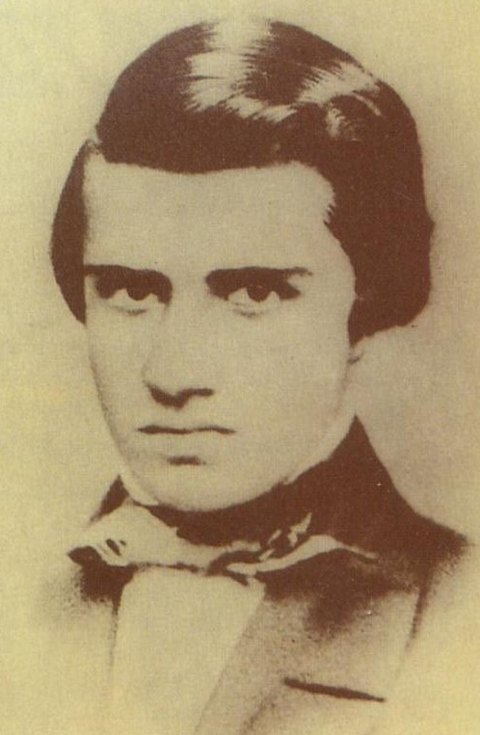
Manuel Antônio Álvares de Azevedo (September 12, 1831 – April 25, 1852), affectionately called "Maneco" by his close friends, relatives and admirers, was a Brazilian Romantic poet, short story writer, playwright and essayist, considered to be one of the major exponents of Ultra-Romanticism and Gothic literature in Brazil. His works tend to play heavily with opposite notions, such as love and death, platonism and sarcasm, sentimentalism and pessimism, among others, and have a strong influence of Musset, Chateaubriand, Lamartine, Goethe, Heine and – above all – Byron.
All of his works were published posthumously due to his premature death at only 20 years old after a horse-riding accident. They acquired strong cult following as years went by, particularly among youths of the goth subculture.
He is the patron of the second chair of the Brazilian Academy of Letters, and of the ninth chair of the Paulista Academy of Letters.