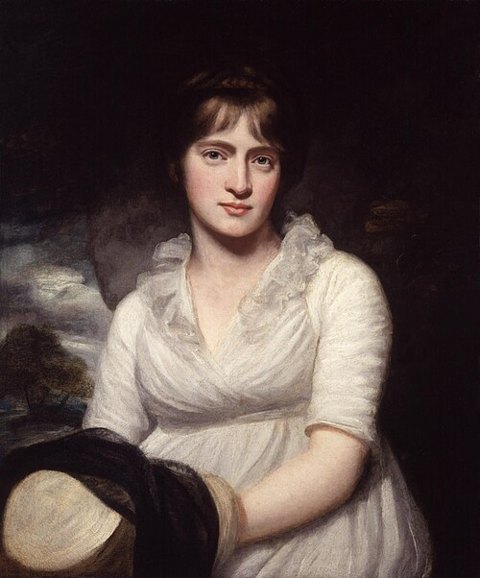
Amelia Opie (born Amelia Alderson; 12 November 1769 – 2 December 1853) was an English author and abolitionist who published numerous novels in the Romantic period up to 1828. A Whig supporter and Bluestocking, Opie was also a leading abolitionist in Norwich. Hers was the first of 187,000 names presented to the British Parliament on a petition from women to stop slavery.
Early life and influences
Amelia Alderson was born on 12 November 1769. An only child, she was the daughter of James Alderson, a physician, and Amelia Briggs of Norwich. Her mother also brought her up to care for those who came from less privileged backgrounds. After her mother's death on 31 December 1784, she became her father's housekeeper and hostess, remaining very close to him until his death in 1807.
According to her biographer, Opie "was vivacious, attractive, interested in fine clothes, educated in genteel accomplishments, and had several admirers." She was able to speak French, having learnt from John Bruckner. She was a cousin of the judge Sir Edward Hall Alderson, with whom she corresponded throughout her life, and was also a cousin of the artist Henry Perronet Briggs. Alderson inherited radical principles and was an ardent admirer of John Horne Tooke. She was close to activists John Philip Kemble, Sarah Siddons, William Godwin and Mary Wollstonecraft. Along with Wollstonecraft, she was connected with the Blue Stockings Society.
Career and connections
Opie spent her youth writing poetry and plays and organizing amateur theatricals. She wrote The Dangers of Coquetry when she was 18 years old and by 1800 her "songs" (poems) - along with those of Georgiana, Duchess of Devonshire, Mrs Barbauld, Peter Pindar and R.B. Sheridan - were published and advertised widely throughout England.