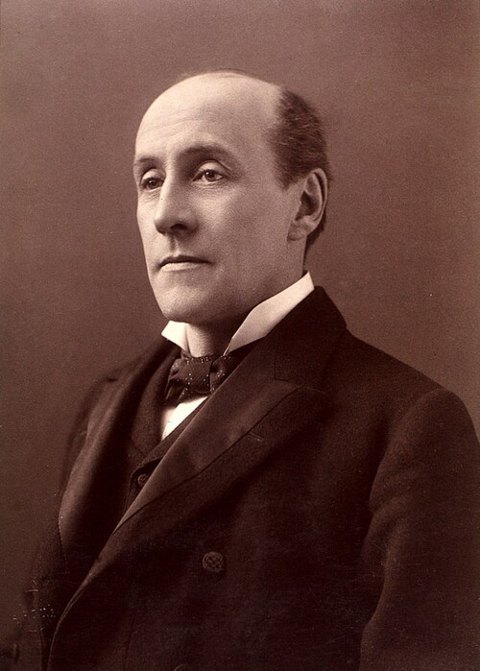
Sir Anthony Hope Hawkins (9 February 1863 – 8 July 1933), better known as Anthony Hope, was a British novelist and playwright. He was a prolific writer, especially of adventure novels but he is remembered predominantly for only two books: The Prisoner of Zenda (1894) and its sequel Rupert of Hentzau (1898).
These works, "minor classics" of English literature, are set in the contemporaneous fictional country of Ruritania and spawned the genre known as Ruritanian romance, books set in fictional European locales similar to the novels. Zenda has inspired many adaptations, most notably the 1937 Hollywood movie of the same name and the 1952 version.
Early career and Zenda
Hope was educated at St John's School, Leatherhead, Marlborough College and Balliol College, Oxford. In an academically distinguished career at Oxford he obtained first-class honours in Classical Moderations (Literis Graecis et Latinis) in 1882 and in Literae Humaniores ("Greats") in 1885.
Hope trained as a lawyer and barrister, being called to the Bar by the Middle Temple in 1887. He served his pupillage under the future Liberal Prime Minister H. H. Asquith, who thought him a promising barrister and who was disappointed by his decision to turn to writing.
Hope had time to write, as his working day was not overfull during these early years and he lived with his widowed father, then Rector of St Bride's Church, Fleet Street. His short pieces appeared in periodicals but for his first book, he was forced to resort to a self-publishing press. A Man of Mark (1890) is notable primarily for its similarities to Zenda: it is set in an imaginary country, Aureataland, and features political upheaval and humour. More novels and short stories followed, including Father Stafford in 1891 and the mildly successful Mr Witt's Widow in 1892. He stood as the Liberal candidate for Wycombe in the election of 1892 but was not elected.