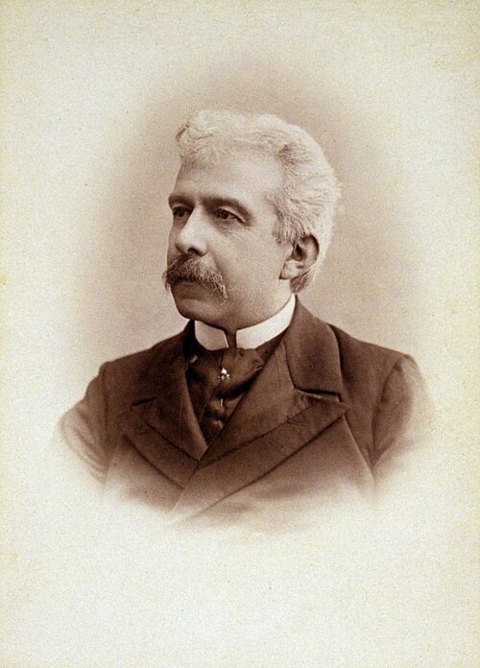
Antonio Fogazzaro (Italian pronunciation: [anˈtɔːnjo foɡatˈtsaːro]; 25 March 1842 – 7 March 1911) was an Italian novelist and proponent of Liberal Catholicism. Fogazzaro has been called "the most eminent Italian novelist since Manzoni." He was nominated for the Nobel Prize in Literature seven times. In Fogazzaro's work there is a constant conflict between sense of duty and passions, faith and reason. In some cases this brings the tormented soul of characters into mystic experiences.
Early life and education
Fogazzaro was born in Vicenza to a wealthy family of industrialists. His father, Mariano, was a devout Catholic and a fervent Italian patriot who, in 1860, was compelled to emigrate, together with his family, to Turin, where they lived for some years in exile. In 1866, Mariano Fogazzaro was elected to the Chamber of Deputies.
As a schoolboy, Antonio read extensively in Italian and learned French and Latin well. For two years (1856–58) he was a student in the liceo (roughly equivalent to our senior high school), where his chief teacher was the poet-priest Giacomo Zanella. From Zanella, the adolescent Fogazzaro learned to love the romantic aspects of Virgil and of German poetry, especially Heine (whom Antonio first read in a French translation). Later, he acquired a thorough knowledge of both German and English, in which latter language he frequently read the Bible.
In obedience to his father's wishes, he studied law at the University of Turin, where he obtained his degree in 1864. In 1865, the Fogazzaro family moved to Milan where Antonio married a noblewoman, Margherita Lampertico di Valmanara. In 1868, he passed his final examinations as a lawyer.