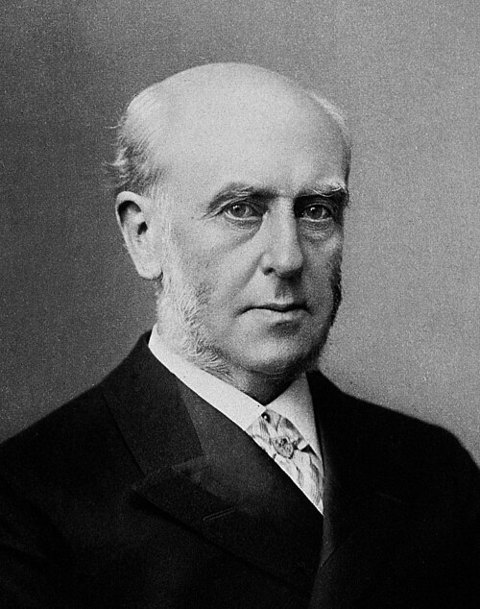
Sir Archibald Geikie (28 December 1835 – 10 November 1924) was a Scottish geologist and writer.
Early life
Geikie was born in Edinburgh in 1835, the eldest son of Isabella Thom and her husband James Stuart Geikie, a musician and music critic. The elder brother of James Geikie, he was educated at Edinburgh High School and University of Edinburgh.
Career
In 1855 Geikie was appointed an assistant with the British Geological Survey. Among his early publications for a popular audience was The Story of a Boulder; or, Gleanings from the Note-Book of a Geologist (1858). His ability at once attracted the notice of his chief, Sir Roderick Murchison, with whom he formed a lifelong friendship, and whose biographer he subsequently became.
Geikie completed some early geological mapping with Murchison on complicated regions of schists in the Scottish Highlands; and they jointly published a new geological map of Scotland in 1862. Geikie completed a larger map in 1892. In 1863 he published an important essay "On the Phenomena of the Glacial Drift of Scotland", in Transactions of the Geological Society of Glasgow, in which the effects of ice action in that country were for the first time clearly and connectedly delineated.
In 1865 Geikie's Scenery of Scotland (3rd edition, 1901) was published, which was, he claimed, the first attempt to elucidate in some detail the history of the topography of a country. In the same year he was elected a Fellow of the Royal Society. At this time the Edinburgh school of geologists, prominent among them Sir Andrew Ramsay, with his Physical Geology and Geography of Great Britain were maintaining the supreme importance of denudation in the configuration of land surfaces, and particularly the erosion of valleys by the action of running water. Geikie's book, based on extensive personal knowledge of the country, was an able contribution to the doctrines of the Edinburgh school, of which he himself soon began to rank as one of the leaders. In 1880, he was elected as a member of the American Philosophical Society.