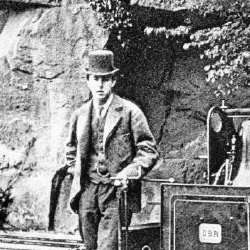
Sir Arthur Percival Heywood, 3rd Baronet (25 December 1849 – 19 April 1916) is best known today as the innovator of the fifteen-inch minimum-gauge railway, for estate use.
Early life
He was the eldest son of Sir Thomas Percival Heywood and grew up in the family home of Dove Leys at Denstone in Staffordshire.
Dove Leys looked over the valley where the North Staffordshire Railway from Rocester to Ashbourne ran. The family travelled by train to their relatives in Manchester and on holiday to Inveran in the Highland region of Scotland. Heywood developed a passion for the railway from an early age.
He assisted his father in his hobby of ornamental metalwork, with a Holtzapffel lathe, and in his late teenage, built a 4 in gauge model railway with a steam locomotive. Wanting something on which his younger siblings could ride, he went on to build a 9 in gauge locomotive and train, which gave him the experience for his later ventures.
Initially schooled at Eton, in 1868, he went on to Trinity College, Cambridge, where he made friends with the local railway people, cadging lifts on the footplates of locos. He graduated in 1872 with a master's degree in Applied Science. The Heywood family originally made its fortune in the trans-Atlantic slavery trade, which operated in Liverpool, and as a landed gentleman, however, convention frowned on him developing an engineering career.
Later life
In 1872 he married his cousin, Margaret Effie, daughter of the Reverend George Sumner, Rector of Alresford in Hampshire, and set up home at Duffield Bank, near Duffield, Derbyshire near Derby, the headquarters of the Midland Railway. Since many of the directors lived in Duffield, he soon developed an interest in Derby Works. He became aware of experiments by the Royal Engineers in building railways in warfare.