My autobiography
Online reading View book
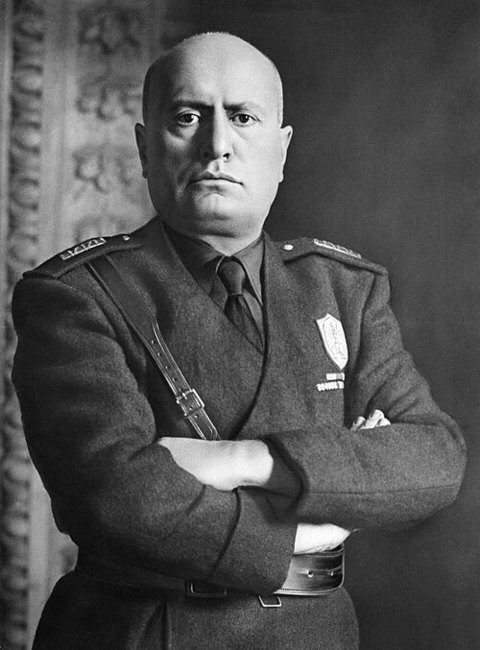
Author
Dictator of Italy from 1922 to 1945
Benito Amilcare Andrea Mussolini (29 July 1883 – 28 April 1945) was a fascist dictator who was the prime minister of Italy from 1922 until his deposition in 1943. Known as Il Duce during his rule, he established a totalitarian dictatorship led by the National Fascist Party (PNF) in the Kingdom of Italy.
Born in Predappio, Mussolini originally worked as a journalist for the Italian Socialist Party (PSI) newspaper Avanti!. He was expelled from the party for advocating military intervention in World War I and called up for the Royal Italian Army in 1915, where he served until his discharge after being wounded in 1917. After the war, Mussolini turned to nationalism and denounced the PSI. He founded the Fasci Italiani di Combattimento in 1919, which opposed egalitarianism and class conflict and instead promoted a form of revolutionary nationalism transcending class lines. The Combattimento are often considered the world's first fascist movement.
The Combattimento were reorganised into the PNF in 1921. Fascist militants marched on Rome and Mussolini was appointed prime minister by King Victor Emmanuel III in 1922. He established the OVRA in 1927 to silence opposition, outlawed labour strikes, and consolidated power through the Acerbo Law among others, transforming Italy from a parliamentary democracy into a one-party state. He ordered the Pacification of Libya, characterised by some scholars as a genocide, and signed the Lateran Treaty to formally establish the Vatican City in 1929. Mussolini generally espoused autarkist and corporatist policies to grow the Italian economy, especially after the Great Depression.
Mussolini's foreign policy shifted from cautious pragmatism to aggressive expansion and close alignment with Nazi Germany in the mid-1930s. Initially, he sought to expand Italy's influence without risking a major conflict with France or Britain, aligning with them during tensions over Austria. However, his invasion of Ethiopia resulted in condemnations from the League of Nations, which isolated Italy diplomatically. This pushed Mussolini toward Adolf Hitler, leading to a rapprochement and the formation of the Rome–Berlin Axis in 1936. Mussolini began militarily supporting Francisco Franco's forces during the Spanish Civil War. Although he acted as a mediator at the Munich Conference in 1938, his ambitions for territorial expansion and growing distrust of the Western powers led him to strengthen ties with Germany, resulting in the creation of the Pact of Steel in 1939.
The wars of the 1930s cost Italy enormous resources, leaving it unprepared for the World War II; Mussolini initially declared Italy's non-belligerence. However, in June 1940, believing that German victory was imminent, he joined the war on Germany's side to share the spoils. Following defeats at the hands of the Allies and the landing in Sicily, the Grand Council of Fascism voted on the Grandi motion, which effectively ended Mussolini's leadership and restored powers to King Victor Emmanuel III who then immediately dismissed Mussolini as head of government and placed him in custody in July 1943. After the king agreed to an armistice with the Allies in September 1943, Mussolini was rescued by the Germans during the Gran Sasso raid. Hitler made Mussolini the figurehead of a puppet state in German-occupied north Italy, the Italian Social Republic, which served as a collaborationist regime of Germany. With Allied victory imminent, Mussolini and his mistress Clara Petacci attempted to flee to Switzerland, but were captured by communist partisans and summarily executed on 28 April 1945.
Text: “Benito Mussolini”, from Wikipedia, the free encyclopedia, under the license CC BY-SA 4.0. Dates and facts: Wikidata.
Collection
1 book