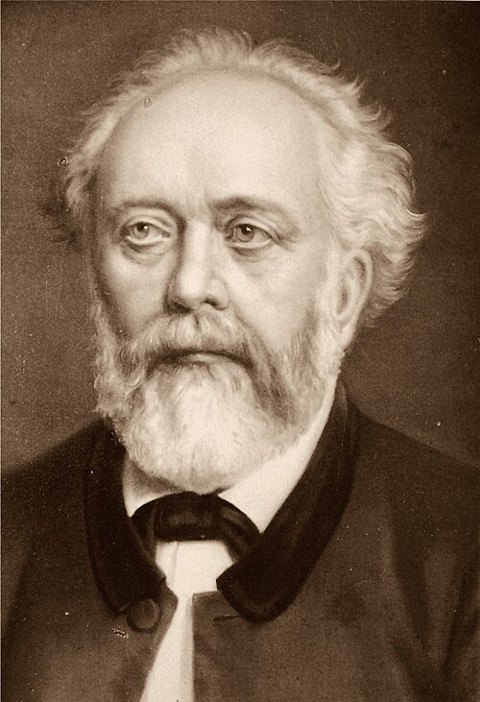
Berthold Auerbach (28 February 1812 – 8 February 1882) was a German poet and author. He was the founder of the German "tendency novel", in which fiction is used as a means of influencing public opinion on social, political, moral, and religious questions.
Biography
Moses (Moyses) Baruch Auerbach was born in Nordstetten (now Horb am Neckar) in the Kingdom of Württemberg. He attended Eberhard-Ludwigs-Gymnasium. He grew up in an impoverished Jewish family and initially pursued rabbinical studies. He was intended for the ministry, but after studying philosophy at the University of Tübingen, the Ludwig-Maximilians-Universität München, and Heidelberg University, and becoming estranged from Jewish orthodoxy by the study of Spinoza, he devoted himself to literature. While a student in Heidelberg and under the pseudonym “Theobald Chauber,” he produced a Biography of Frederick the Great (1834–36).
Another early publication was entitled Das Judentum und die neueste Litteratur (Judaism and Recent Literature; 1836), and was to be followed by a series of novels taken from Jewish history. Of this intended series he actually published, with considerable success, Spinoza (1837) and Dichter und Kaufmann ("Poet and Merchant"; 1839), based on the life of Ephraim Kuh. His romance on the life of Spinoza adheres so closely to fact that it may be read with equal advantage as a novel or as a biography. In 1841, he created a translation of Spinoza's works. In 1842, he wrote Der gebildete Bürger ("The Educated Citizen"), an attempt to popularize philosophical subjects.