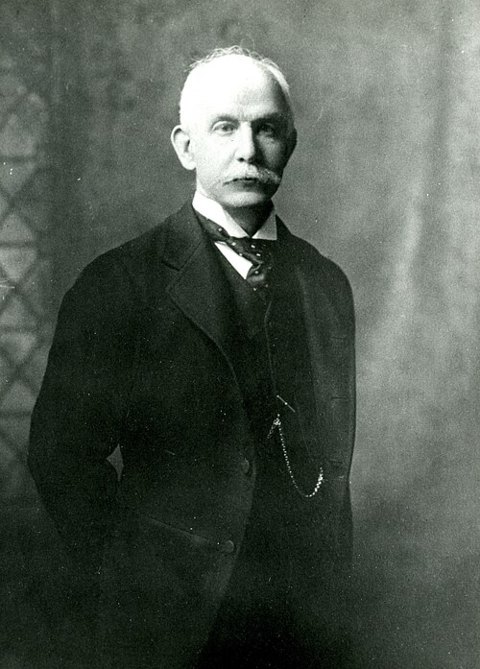
Peter Chardon Brooks Adams (June 24, 1848 – February 13, 1927) was an American attorney, historian, political scientist and critic of capitalism.
Early life and education
Adams was born in Quincy, Massachusetts, on June 24, 1848, son of Charles Francis Adams and Abigail Brown Brooks. He attended schools in the United States and in Europe.
Adams was a great-grandson of Founding Father and President John Adams, a grandson of President John Quincy Adams, the youngest son of U.S. diplomat Charles Francis Adams, and brother to Charles Francis Adams Jr. and Henry Adams. Henry was himself a philosopher, historian, and novelist, whose theories of history were influenced by his brother's work. His maternal grandfather was Peter Chardon Brooks, the wealthiest man in Boston at the time of his death.
He graduated from Harvard University in 1870 and studied at Harvard Law School in 1870 and 1871. Adams was secretary to his father in Geneva, in 1872, where the latter was an arbitrator upon the Alabama claims, under the Treaty of Washington. He was admitted to the bar in 1873, practiced law in Boston until 1881, and then devoted himself to literary work.
Social theories
Adams believed that commercial civilizations rise and fall in predictable cycles. First, masses of people draw together in large population centers and engage in commercial activities. As their desire for wealth grows, they discard spiritual and creative values. Their greed leads to distrust and dishonesty, and eventually the society crumbles when a new, more economically energetic society takes its place.