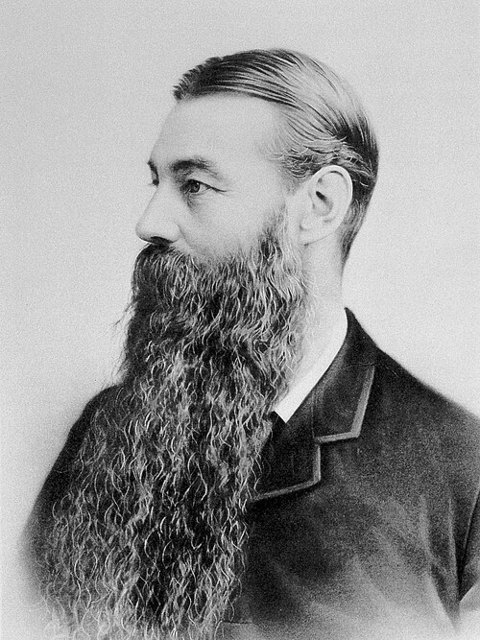
Conwy Lloyd Morgan, FRS (6 February 1852 – 6 March 1936) was a British ethologist and psychologist. He is remembered for his theory of emergent evolution, and for the experimental approach to animal psychology now known as Morgan's Canon, a principle that played a major role in behaviourism, insisting that higher mental faculties should only be considered as explanations if lower faculties could not explain a behaviour.
Life
Conwy Lloyd Morgan was born in London and studied at the Royal School of Mines and subsequently under T. H. Huxley. He taught in Cape Town, but in 1884 joined the staff of the then University College, Bristol as Professor of Geology and Zoology, and carried out some research of local interest in those fields. However, he quickly became interested in the field he called "mental evolution", the borderland between intelligence and instinct, and in 1901 moved to become the college's first Professor of Psychology and Education. He was elected a Fellow of the Royal Society in 1899, and gave the Croonian Lecture in 1901, titled Studies in visual sensation.
In addition to his scientific work, Lloyd Morgan was active in academic administration. He became Principal of the University College, Bristol, in 1891, playing a central role in the campaign to secure it full university sltatus. In 1893, he enrolled his son, C. Lloyd Morgan, at Bristol's Clifton College. In 1909, when, with the award of a Royal Charter, the University College, Bristol became the University of Bristol and he was appointed as its first Vice-Chancellor, an office he held for a year before deciding to become Professor of Psychology and Ethics until his retirement in 1919. He was president of the Aristotelian Society from 1926 to 1927.