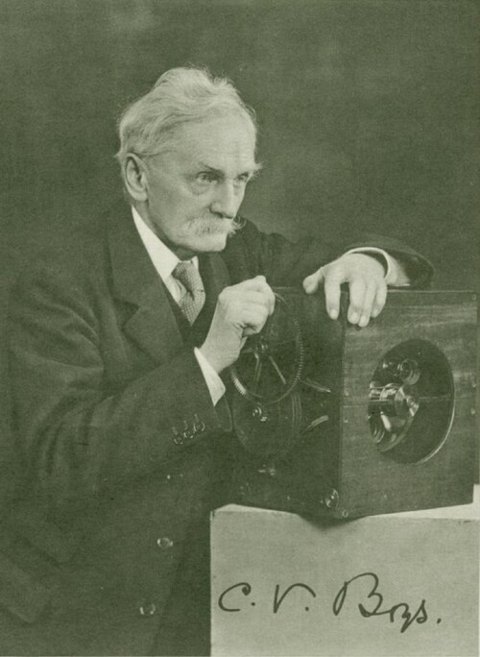
Sir Charles Vernon Boys, FRS (15 March 1855 – 30 March 1944) was a British physicist, known for his careful and innovative experimental work in the fields of thermodynamics and high-speed photography, and as a popular science communicator through his books, inventions, and his public lectures for children.
Early life
Boys was the eighth child of the Reverend Charles Boys, the Anglican vicar of Wing, Rutland. He was educated at Marlborough College and the Royal School of Mines, where he learned physics from Frederick Guthrie and taught himself higher mathematics while completing a degree in mining and metallurgy. As a student at the School of Mines he invented a mechanical device (which he called the "integraph") for plotting the integral of a function. He worked briefly in the coal industry before accepting Guthrie's offer of a position as "demonstrator."
Experimental physics
Boys achieved recognition as a scientist for his invention of the fused quartz fibre torsion balance, which allowed him to measure extremely small forces. He made the fused quartz fibres for his instrument by attaching one end of a quartz rod to a crossbow quarrel, the other end to a fixed surface, heating the rod to the point of melting, and shooting the crossbow. This "drew out" the rod into a long thin string, often less than one micron in width, a fiber so thin it could not be resolved with an optical microscope of the time.
Boys used the quartz fibre torsion balance to produce a radiomicrometer capable of responding to the light of a single candle more than one mile away, and used that device for astronomical observations. He then used that same balance to improve upon Cavendish's measurement of the gravitational constant G. Boys published his measurement of G in 1894. His method was based on the same basic setup as Cavendish's, but with two masses suspended at one height and two nearby masses suspended at a different height, in order to minimise the unwanted interaction between opposite masses.