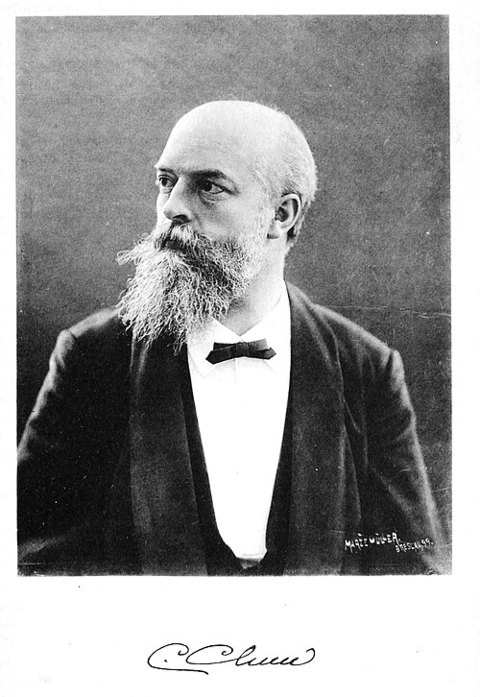
Carl Chun or Karl Friedrich Gustav Chun (German pronunciation: [ˈkuːn]; 1 October 1852 – 11 April 1914) was a German marine biologist who worked as a professor at the Universities of Königsberg (1883), Breslau (1891) and Leipzig (1898). He was a pioneer of German oceanographic research, organizing the first deep-sea expedition aboard the SS Valdivia in 1898-99. He spent much of his life studying the collections made during the expedition, and was responsible for discovering many marine organisms, including the vampire squid.
Life and work
Chun was born in Höchst, today a part of Frankfurt, where his father Gustav (1827–1907) was rector of the Weißfrauenschule. Chun went to the Lessing Gymnasium and became interested in zoology from an early age thanks to the Senckenberg Museum in Frankfurt where he listened to lectures by Fritz Noll, Hermann Theodor Geyler, and Karl von Fritsch. He studied at the University of Göttingen and then at the University of Leipzig, receiving a doctorate in 1874. From 1878 to 1883 he was privat-docent of zoology and an assistant to Rudolf Leuckart. Chun became deeply interested in oceanic organisms and worked at the Naples Zoological Station where he studied and published a monograph on comb jellyfish under Anton Dohrn. He completed his habilitation in Leipzig (1878) and became a professor at the University of Königsberg (1883–1891). He moved to Breslau in 1891 and succeeded Leuckart at Leipzig in 1898.
Chun was among the first to study and describe siphonophores, the first of which he received from an Italian naval officer who found a specimen at the depth of 1000 m. In order to sample at this depth, he got the engineer of the Naples station, Peterson to design a trap now known as "Peterson Closing Net" in 1887. Using this special device he was able to sample at specific depths.